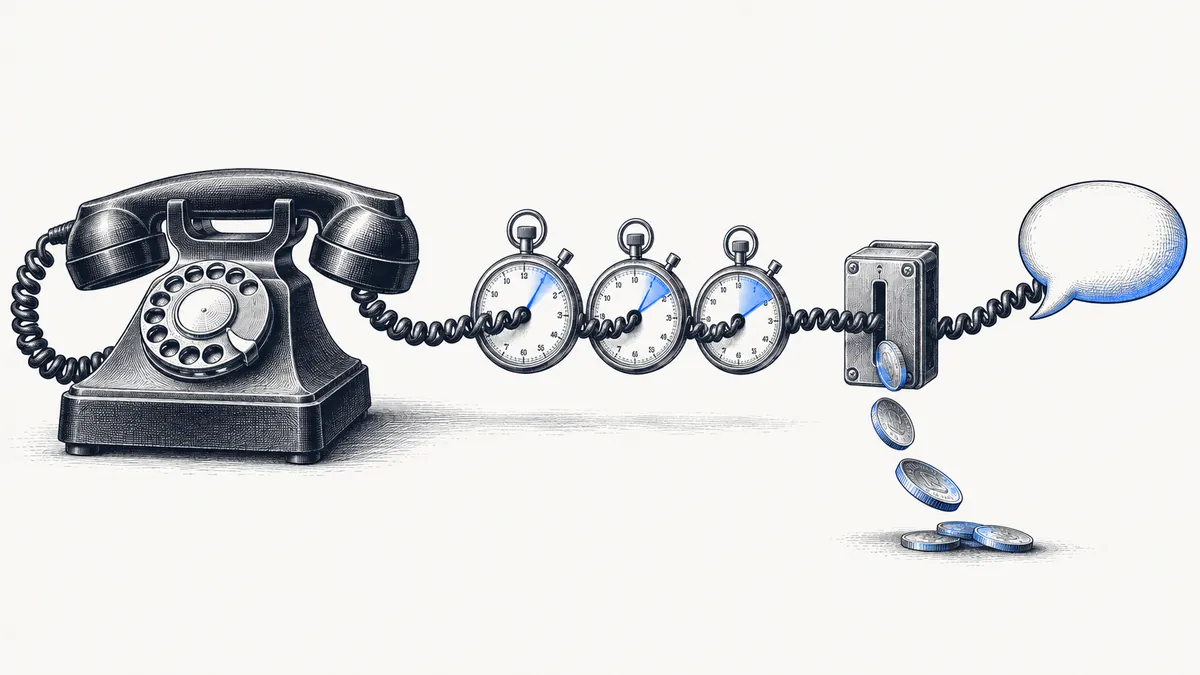
A customer clicks your Google ad at 9:40 p.m., calls the number on your site, and gets voicemail. They don't leave a message. They call the next business on the list. An answering service exists to stop exactly that, and the answering service cost in 2026 depends almost entirely on how the provider bills: live human answering runs from about US$1.49 to US$5.00 per minute, or US$7 to US$10 per call, while AI receptionists answer for roughly US$1.60 to US$3.00 per call (vendor pricing pages for PATLive, Abby Connect and Smith.ai, checked October 2026). The headline plan price tells you very little. Call length, rounding rules, spam calls and overage decide the bill.
This guide compares per-minute, per-call and AI plans from the vendors that publish prices, works through two real monthly scenarios, lists the hidden fees to check, and is honest about where a phone service fits and where your leak is actually in chat. All prices are in USD, as of October 2026.
How much does an answering service cost per month in 2026?
A live answering service costs roughly US$100 to US$810 a month for a business taking 20 to 200 calls, and well over US$1,000 once you pass about 300 calls. The cheapest entry point is pay-as-you-go: PATLive charges US$49 a month plus US$2.99 per minute with no minutes included (PATLive, 2026).
Here is what the main US providers publish, as of October 2026:
| Provider | How it bills | Entry plan | Mid plan | Larger plan | Source |
|---|---|---|---|---|---|
| PATLive (human only) | Per minute | $99 for 50 min | $349 for 200 min | $759 for 500 min | patlive.com/pricing |
| Ruby (human) | Per minute | $250 for 50 min | $720 for 200 min | $1,725 for 500 min | ruby.com/plans-and-pricing |
| Abby Connect (human + AI) | Per "Abby Minute" | $165 for 50 | $599 for 200 | $1,380 for 500 | abby.com |
| Smith.ai Virtual Receptionists (human) | Per call | $300 for 30 calls | $810 for 90 calls | $2,100 for 300 calls | smith.ai/receptionists |
| Smith.ai AI Receptionist | Per call | Free for 25 calls | $150 for 75 calls | $500 for 300 calls | smith.ai/pricing |
| AnswerConnect, MAP Communications | Quote | Not public (contact sales) | — | — | Vendor quote forms |
Divide each plan by what it includes and the per-unit cost becomes clearer. PATLive's 200-minute plan works out at about US$1.75 a minute, Ruby's 200-minute plan at US$3.60, and Smith.ai's human Pro plan at US$7.00 a call. The bigger the plan, the lower the unit price, which is the usual volume discount. The catch is that you pay for the plan whether or not the phone rings.
What is the difference between per-minute and per-call pricing?
Per-minute plans charge for the time a receptionist spends on your calls, so short calls are cheap and long ones are expensive. Per-call plans charge a flat amount per call regardless of length, so they only win when your calls are long.
The break-even is easy to work out. Smith.ai's human Pro plan costs US$7.00 per call. PATLive's overage on its 500-minute plan is US$1.79 a minute. Divide one by the other and a call has to last about 3.9 minutes before per-call pricing becomes the cheaper option (arithmetic from Smith.ai and PATLive, October 2026).
Most enquiry calls are shorter than that. "Are you open Saturday?", "How much is a consultation?", "Can I book for Thursday?" These are one- or two-minute calls. If that's what your phone mostly gets, per-minute pricing is likely cheaper. Per-call pricing suits businesses with long intake calls, such as law firms taking case details, where a single call can run past five minutes.
Per-call pricing has one other advantage: it's predictable. You know a call costs the same whether the caller is brief or chatty. Smith.ai states it charges per call, not per minute, so call length doesn't change the bill (Smith.ai, 2026).
How much does an AI receptionist cost compared with a human answering service?
An AI receptionist costs roughly a fifth to a quarter of a human service per call. Smith.ai's AI plans run from US$2.00 per call on the 75-call plan down to US$1.60 on the 500-call plan, against US$7.00 to US$10.00 per call on its human plans (Smith.ai, 2026).
The Smith.ai AI ladder, as of October 2026:
| AI plan | Monthly | Calls included | Per call in plan | Extra call |
|---|---|---|---|---|
| Free | $0 | 25 | — | $3.00 |
| Pro | $150 / $270 / $500 | 75 / 150 / 300 | $2.00 / $1.80 / $1.67 | $2.50 / $2.30 / $2.17 |
| Enterprise | $500 / $800 / custom | 300 / 500 / 1,000+ | $1.67 / $1.60 / custom | $2.17 / $2.10 / custom |
Source: smith.ai/pricing/ai-receptionist, checked October 2026.
Abby Connect takes a different route. It bills AI and human time from the same pool of "Abby Minutes", and an AI minute counts as half: "1 minute of call = 0.5 Abby Minute, so AI goes twice as far" (Abby Connect, 2026). PATLive sits at the other end. Its pricing page says plainly that "PATLive does not use AI to answer calls."
Cheaper doesn't automatically mean better. AI handles routine calls well: hours, prices, booking. A good human receptionist still handles the upset caller, the complicated request and the caller who just wants a person. One four-star Smith.ai reviewer put it bluntly: "the AI isn't the favorite of our clients" (Trustpilot, 2025). For a deeper look at the trade-offs, see our guide to voice AI agents in customer service and our comparison of an AI receptionist vs an AI chat agent.
What are the hidden fees in an answering service?
The biggest hidden costs are rounding, after-call work, spam calls and overage rates that aren't published. Night, weekend and holiday surcharges, the fee people worry about most, are now rare among the big providers.
Here's what to check on any quote:
- Rounding. Ruby bills "rounded up in 60-second increments", so a 2-minute-10-second call costs 3 minutes (Ruby, 2026). If your average call is 2.5 minutes and every call rounds up to 3, you're paying for 20% more time than was spent on the phone.
- After-call work. Ruby's billable time runs until the receptionist "completes any after-call notes". PATLive says the opposite: "We don't charge for after-call notes, message entry, or wrap-up" (PATLive, 2026). On a busy month, that difference alone can be worth hundreds of dollars.
- Overage rates. Ruby's pricing page doesn't publish its overage rate. Abby says "Overage is billed at your plan's Abby Minute rate", which works out at US$3.30 a minute on Starter and US$2.76 on Growth by our arithmetic. Smith.ai's human-plan overage is reported by third parties at US$11.50, US$10.50 and US$8.50 per extra call on Starter, Basic and Pro, but isn't shown on its plan page. Ask for the overage rate in writing.
- Spam calls. On Smith.ai's AI plans, calls from "20 million+ known spammers" are filtered out before the AI answers, and you can remove up to 10% of your calls from each bill as spam. Spam beyond that is billed (Smith.ai, 2026). On its human plans, Smith.ai says "We don't charge for spam or blocked sales calls", unless your forwarding service strips the caller ID.
- Taxes. PATLive's prices are "Plus government taxes and fees." Budget a few percent on top.
- Notice periods. All the vendors above are month-to-month, but Smith.ai's AI plans need 30 days' notice to cancel.
The good news is on setup and after-hours fees. Ruby says there are "no additional or hidden fees for activation, onboarding, setup, customization, or coverage during certain periods". PATLive advertises "No night or weekend fees" and 24/7/365 coverage including holidays, and Abby lists "No Setup Fee" on every plan. Smith.ai says "You control exactly when we pick up", with per-call pricing that stays the same whatever the hour.
What does an answering service really cost? Two worked examples
For a small business taking 60 after-hours calls a month, an answering service costs between US$150 and about US$810 depending on the model. For 300 after-hours calls, it ranges from US$500 for AI to more than US$2,000 for some human plans.
Example 1: 60 after-hours calls a month at 3 minutes each (180 minutes). This is a clinic, studio or agency that closes at 6 p.m. and runs ads into the evening.
| Option | Arithmetic | Monthly cost |
|---|---|---|
| Smith.ai AI Pro (75 calls) | 60 calls fit in 75 | $150 |
| PATLive 200-minute plan | 180 minutes fit in 200 | $349 |
| Abby Connect Professional (200) | 180 minutes fit in 200 | $599 |
| Ruby 200-minute plan | 180 minutes, more with rounding and notes | $720 |
| Smith.ai human Basic (90 calls) | 60 calls fit in 90 | $810 |
Example 2: 300 after-hours calls a month at 2.5 minutes each (750 minutes). A busy home-services or medical practice running ads every night.
| Option | Arithmetic | Monthly cost |
|---|---|---|
| Smith.ai AI Pro (300 calls) | 300 calls in plan | $500 |
| PATLive, billed exactly | $759 for 500 min + 250 × $1.79 | $1,206.50 |
| PATLive, if calls averaged 3 min (900 min) | $759 + 400 × $1.79 | $1,475 |
| Abby Connect, all human | $1,380 for 500 + 250 × $2.76 | ≈ $2,070 |
| Ruby (500-minute plan) | $1,725 + overage at an unpublished rate | $1,725 + overage |
| Smith.ai human Pro (300 calls) | 300 calls in plan | $2,100 |
All arithmetic from vendor pricing pages, checked October 2026.
Two patterns stand out. At short call lengths, per-minute human plans beat per-call human plans. And AI per-call pricing undercuts every human option in both examples, by between about 2.4 and 4 times at the larger volume. Neither example includes the hidden fees above, so treat these as floors.
Is an answering service worth the cost?
An answering service is worth it if missed phone calls are costing you more than the monthly fee. One booked job or consultation a month often covers the whole bill.
Run the sum for your own business. If a new customer is worth US$500 to you and an answering service at US$349 a month saves even one of them, it has paid for itself. Ruby, citing the US Bureau of Labor Statistics, puts the median receptionist wage at US$17.90 an hour as of May 2024 (Ruby, 2026). That's around US$3,100 a month for a full-time hire before benefits, and a full-time hire still goes home at six.
What an answering service won't do is make your phone the right channel for everyone. Many people who click your ad never call. They type into the chat box on your website, or message you on WhatsApp, and that's where the second leak sits. We cover why speed matters on every channel in our lead response time statistics for 2026.
Phone or chat: which leak are you paying to fix?
Phone and chat are two different leaks, and an answering service only plugs one of them. Before you buy, check where your missed enquiries actually come from.
Some customers want to talk. An emergency plumbing job, an urgent legal question or an older customer who prefers a voice will call, and for them an answering service or AI receptionist is the right answer. Our guide to after-hours answering services vs AI covers that decision in detail.
Other customers would never call. They're on their phone at 11 p.m., they've clicked your ad, and they'll type a question into the chat box or WhatsApp and wait about as long as it takes to open a competitor's page. Answering services do sell chat, but they price it per chat: Ruby's live chat starts at US$143 for 10 chats a month, and PATLive's at US$149 for 25 chats, with extra chats at US$8.95 each on that plan (Ruby; PATLive, 2026). At 100 chats a month, that's US$499 on PATLive's 100-chat plan.
To be plain about it: Omago does not answer phone calls. It's an AI sales agent that answers on your website, WhatsApp and Telegram, from your own content, qualifies the enquiry and books the next step, for a flat US$49–99 a month with no per-chat or per-resolution fees (pricing). If your leak is the phone, buy phone cover. If it's the chat box and WhatsApp, a per-chat human service is an expensive way to fix it. Our WhatsApp page shows how that channel works, and many businesses end up running both: a phone service for callers, and a chat agent for everyone who types.
How do you choose the cheapest answering service for your business?
Pick the billing model that matches your call length, size the plan to a normal month, and get the overage and rounding rules in writing. The cheapest plan on paper is often not the cheapest bill.
A quick decision checklist:
- Measure first. Pull a month of call logs: how many calls, how long, and what share came after hours. Without this you're guessing.
- Short calls (under about 4 minutes)? Per-minute plans usually win. Check rounding and after-call billing.
- Long intake calls? Per-call plans like Smith.ai's become better value.
- Mostly routine questions? An AI receptionist at US$1.60 to US$3.00 per call is the cheapest phone option, with a human handoff for the rest.
- Spiky months? Compare overage rates, not just plan prices. A plan sized for a normal month will hit overage in your busiest one.
- Mostly chat and WhatsApp enquiries? Fix that leak separately. Our breakdown of Zendesk pricing in 2026 shows how per-resolution chat billing grows in a busy month too.
Then test the channel your customers actually use. Paste your website URL into Omago and ask it the question your customers ask at 11 p.m.
Frequently asked questions
How much does a 24/7 answering service cost per month?
As of October 2026, live 24/7 answering starts at US$49 a month plus US$2.99 a minute on PATLive's pay-as-you-go plan, or US$99 for 50 minutes. Mid-sized plans run US$349 to US$810, and plans covering 300 or more calls run US$1,200 to US$2,100 for human answering (PATLive; Smith.ai, 2026). AI receptionists cost less, from US$150 for 75 calls.
Do answering services charge extra for nights, weekends or holidays?
The large providers mostly don't. PATLive advertises "No night or weekend fees" and holiday coverage, Ruby lists no fees for "coverage during certain periods", and Smith.ai prices calls the same whatever the time (PATLive; Ruby; Smith.ai, 2026). Always confirm in writing for quote-only providers.
Is per-minute or per-call pricing cheaper?
Per-minute pricing is usually cheaper for short calls, and per-call pricing for long ones. Comparing Smith.ai's US$7.00 per call with PATLive's US$1.79 overage minute, the break-even is about 3.9 minutes per call. Most enquiry calls are shorter, which favours per-minute plans.
Do answering services charge for spam calls?
It depends on the provider. Smith.ai doesn't charge for spam on its human plans unless caller ID is stripped, and on its AI plans it filters known spammers and lets you remove up to 10% of calls a month (Smith.ai, 2026). Per-minute services generally bill any call answered, so ask about spam before you sign.
Can an AI chat agent replace an answering service?
Not for phone calls. An AI chat agent answers people who type on your website or WhatsApp, while an answering service answers people who call. If most of your missed enquiries are calls, you need phone cover. If most are chats, a flat-priced chat agent is usually cheaper than per-chat human services at roughly US$5 to US$14 a chat. Many businesses run both.
Sources: PATLive pricing page (2026), Ruby plans and pricing page (2026), Ruby blog on virtual receptionist pricing (2026), Ruby citing US Bureau of Labor Statistics (May 2024), Abby Connect virtual receptionist page (2026), Smith.ai AI Receptionist pricing (2026), Smith.ai Virtual Receptionists page (2026), Trustpilot (2025). Smith.ai human-plan overage reported by third parties, not shown on the vendor page. Prices checked October 2026.