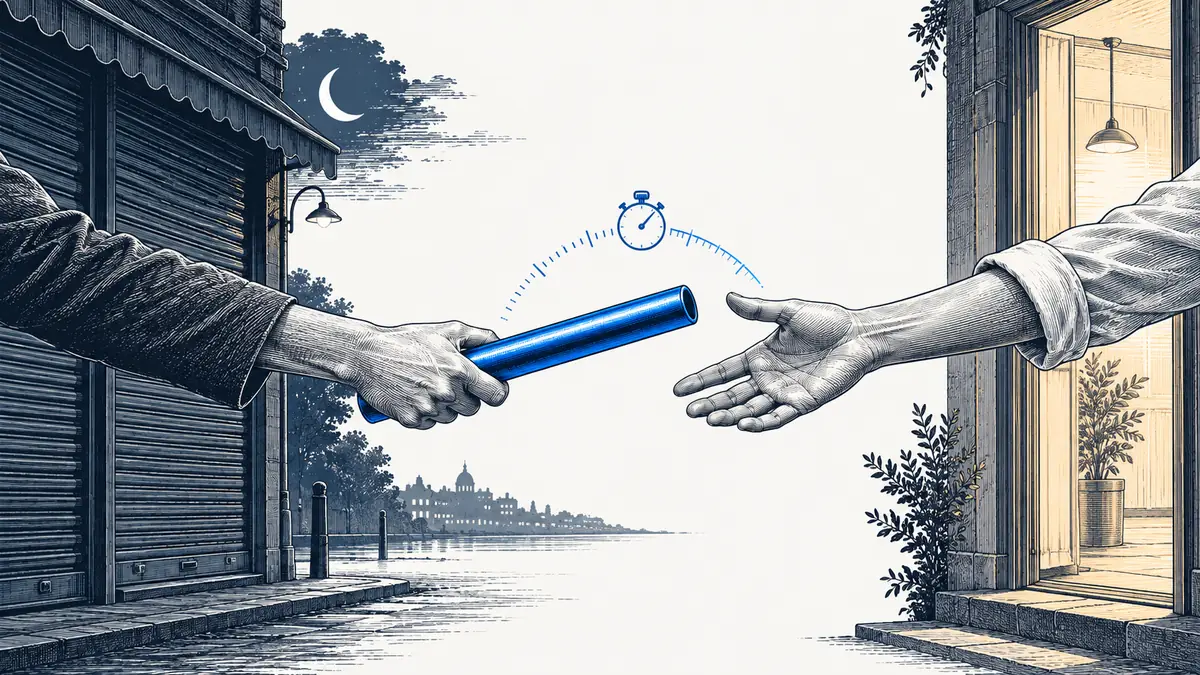
A lead fills in your form at 9:47 p.m. on a Thursday. You paid for that click. They also filled in two of your competitors' forms in the same ten minutes, and whoever replies first with something useful usually gets the booking. That's speed to lead in one scene, and it's why the classic research is so blunt: firms that contacted a lead within 5 minutes rather than 30 were 100 times more likely to reach them and 21 times more likely to qualify them (MIT / InsideSales.com, 2007). Most guides stop at the statistic. This one is the operating playbook for a business without a night shift: who answers, what they say, how leads get routed, and how you measure whether it's working.
If you want every study on response time in one place, with sample sizes and funding, see our lead response time statistics for 2026. This post deliberately uses only three of them and spends the rest of the space on what to do.
What is speed to lead, and what is a good target?
Speed to lead is the time between a prospect contacting you and receiving a useful first response. A good target is under 5 minutes, every hour of every day, with a human follow-up for qualified leads within one business hour.
Two words in that definition do the work. "Useful" means the reply answers what they asked or moves them to the next step. An auto-acknowledgement saying "thanks, we'll be in touch" doesn't count, because it doesn't stop the prospect from moving on to the next tab. "Every hour" means the target applies at 9:47 p.m. on Thursday and at 2 p.m. on Sunday, not just during your opening hours.
The 5-minute figure comes from the 2007 Lead Response Management Study by Dr James Oldroyd and InsideSales.com, which compared contact and qualification odds at 5 minutes versus 30 (MIT / InsideSales.com, 2007). It's old and vendor-funded, and the exact multiples shouldn't be treated as precise. The direction has held up in every study since: the first useful reply wins disproportionately.
Here's the full target set, which the rest of this playbook builds toward:
| Measure | Target | Why |
|---|---|---|
| First useful response | Under 5 minutes, 24/7 | The window in which the prospect is still on your page or in the chat |
| Human follow-up on qualified leads | Within 1 business hour | Hand the warm lead to a person while it's warm |
| Leads never answered | 0% | The worst outcome, and the one averages hide |
| Leads asked to book | 100% of qualified leads | Asking is the step most teams skip |
Why do businesses without a night shift miss the 5-minute window?
They miss it because leads don't arrive on staff schedules, and nobody is assigned to the ones that come in after close. The miss usually isn't laziness. It's a gap in the design.
Look at how far off typical behaviour is. Harvard Business Review's audit of 2,241 US companies found an average first response to a web lead of 42 hours, and 23% never responded at all (HBR, 2011). More recently, Workato audited 114 B2B companies and found that none called a new lead within 5 minutes, only 1 sent a personalised email within 5 minutes, and the average phone response took 14 hours 29 minutes (Workato, published 2026; the study date isn't given). These are two of the three response-time studies this post uses, and they say the same thing fifteen years apart.
Phone leads leak too. CallRail's platform data shows 28% of business calls go unanswered on average (CallRail, 2026), and Invoca's 2026 benchmark of more than 70 million calls found only 56% of callers to businesses speak with a person (Invoca, 2026). Both are vendor datasets. Together they show that even the channel businesses treat as most urgent leaks heavily when nobody is assigned to it.
Three design gaps cause most of the miss:
- No owner after hours. During the day, leads land in a shared inbox that someone checks. After close, they land in the same inbox and nobody checks it.
- No rule for unclaimed leads. A lead assigned to a salesperson who's on a job or on leave just sits there.
- No measurement. If nobody tracks response time, nobody notices it's measured in hours.
The playbook below fixes each one: coverage, a first message, routing and measurement.
Who should answer your leads after hours?
Pick one after-hours coverage model on purpose, rather than letting it default to "whoever checks their phone." There are four realistic options, and each has a clear cost and a clear failure mode.
| Model | How it works | Strength | Weakness | Best fit |
|---|---|---|---|---|
| On-call rota | Staff take turns carrying the lead phone or inbox at night | Cheap; a real person who knows the business | Burnout; slow when the on-call person is asleep or busy | Very low lead volume, emergency trades |
| Human answering service | Shared live agents answer on a script | Empathy; good for distressed callers and emergencies | Often takes a message rather than booking; per-call or per-minute fees | Phone-heavy businesses, medical and legal triage |
| AI first response | An AI agent answers web and messaging leads instantly, qualifies, offers times | Instant at any hour; answers unlimited leads at once; written record | Only as good as the content it's given; must hand off cleanly | Ad-driven web and WhatsApp leads |
| Hybrid | AI answers first; a person picks up qualified or sensitive leads next morning or on escalation | Speed plus judgment | Needs a clear handoff rule | Most businesses that pay for ads |
Match the model to the channel the lead uses. If most of your leads call, you need phone coverage: a person, an answering service or a voice AI. We compare those in after-hours answering service vs AI and AI receptionist vs AI chat agent. If most of your leads arrive through the website form, live chat or WhatsApp, an AI first response covers the 5-minute target for those without anyone working nights.
Be clear about which leak you're fixing. Phone and chat are two different leaks, and a tool for one doesn't cover the other. Omago, for example, answers on the website, WhatsApp and Telegram. It doesn't answer phone calls, so a phone-heavy business would pair it with phone cover rather than replace one with the other.
The channel mix varies a lot by industry. Ruler Analytics' 2026 benchmark found calls make up 56.3% of conversions in legal and 52.6% in professional services, but only 7.8% in beauty and cosmetics, where web forms carry almost everything else (Ruler Analytics, 2026). Ruler's data leans UK, so use it as a pattern. Check your own split before choosing a model: count last month's leads by channel and by hour.
What should the first reply to a new lead say?
The first reply should name your business, confirm what the person asked for, answer it if you can, ask one or two qualifying questions, and offer a next step they can take straight away. All of that fits in four or five sentences.
Most first replies fail on the last part. Invoca's 2025 benchmark of more than 60 million calls found only 35% of agents asked phone leads to buy or book, even though 37% of phone leads converted on the call (Invoca, 2025). If people convert when asked and most aren't asked, the cheapest improvement available is to ask every time.
A template that works across web chat, WhatsApp and email:
"Hi Sarah, this is [Business] — thanks for asking about [service]. [Direct answer: price range, availability or what's included.] To point you to the right option, can I check [qualifying question 1] and [qualifying question 2]? I have [two specific times] open this week, or you can pick a slot here: [booking link]."
Rules for the first message:
- Answer before you ask. If they asked about price, give the range first. Asking for their phone number before answering feels like a trap.
- Two qualifying questions, no more. Budget, timing, location or eligibility, whichever separates a serious lead from a browser in your business.
- Offer a concrete next step. Two specific times, or a booking link. "Let us know if you have questions" isn't a next step.
- Say who's answering. If an AI is replying, say so plainly and tell them how to reach a person. It's the honest default, and it's what several US state laws expect.
- Give an urgent path. For trades, clinics and anything with emergencies, include a number or instruction for urgent cases.
If you're writing these flows for an AI agent, our guide to designing conversation flows covers branching for the common question types. If you're using the WhatsApp Business app's built-in greeting and away messages, our WhatsApp Business auto reply setup guide shows where those stop being enough.
How should you route leads so none sit unclaimed?
Every lead needs exactly one owner within minutes, and an automatic rule that reassigns it if the owner doesn't act. Routing is what turns a fast first reply into a fast human follow-up.
The Workato audit shows the size of the effect: companies using lead-routing tools responded in about 3 hours 32 minutes, against nearly 13 hours for companies without them (Workato, 2026). That's the third and last response-time study this post uses, and it's the most practical one. The gap comes from removing the "who's taking this?" pause.
A routing setup for a small team:
- One intake point. Web form, chat and WhatsApp leads land in one place, whether that's a CRM, a shared inbox or a spreadsheet, with the channel and time stamped.
- Assignment rule. Round-robin between salespeople, or by territory or service line. During office hours, the assignee gets an instant notification.
- Claim timer. If the assignee hasn't replied within your SLA (say 15 minutes in hours), the lead goes to the next person or to the owner.
- After-hours rule. Leads that arrive after close go to your chosen coverage model from the section above, then land at the top of the morning queue with the conversation so far attached.
- Handoff rule from AI to human. Define which leads go to a person: anything above a value threshold, any complaint, any medical or legal question, anyone who asks for a human.
How do you measure speed to lead?
Measure the median time to first useful response, the share of leads never answered, and the lead-to-booking rate, each split by channel and by in-hours versus after-hours. Those few numbers tell you more than a single average ever will.
Why the median and not the average? Because averages behave badly here. A handful of leads answered after a long weekend can drag an average into dozens of hours, while a team that answers most leads in minutes but forgets a few shows a fine-looking median and a hidden leak. Track both, and track "never answered" as its own number so it can't hide in either.
A weekly scorecard you can keep in a spreadsheet:
| Metric | How to calculate | Target |
|---|---|---|
| Median first response, in hours | Median of (first useful reply minus enquiry time) for leads that arrived 9–6 | Under 5 minutes |
| Median first response, after hours | Same, for leads outside 9–6 and on weekends | Under 5 minutes |
| Never answered | Leads with no reply after 24 hours ÷ all leads | 0% |
| After-hours share | Leads outside 9–6 ÷ all leads | Know your number |
| Asked to book | Qualified leads offered a time or link ÷ qualified leads | 100% |
| Lead-to-booking rate | Bookings ÷ leads, by channel | Rising month on month |
Two cautions. First, measure from the customer's side: the clock starts when they submitted, not when someone opened the inbox. Second, measure by channel. Phone, form and WhatsApp leads often have very different response times, and a blended number hides the weakest one. For a fuller set of KPIs after you add an AI agent, see the 30-60-90 day KPI plan for AI agents.
If you're paying for the traffic, add one more line: cost per booked appointment. Speed is only the input. A kept appointment from a lead you paid for is the outcome.
What results can you expect when speed to lead improves?
Expect more conversations to turn into bookings, but treat the published case studies as direction, not forecast. Nearly every named example in this space is published by the vendor that sold the tool.
Two examples, both vendor-published and worth reading with that in mind:
- Payless Kitchen & Bath, a remodeller in California using Hatch, cut reply times from about 33 minutes to about 4 minutes and went from roughly 1 demo a week to 8–14 demos a week (Hatch, customer story). The page doesn't say how much of the change came from speed and how much from a dedicated chat team.
- Sage & Honey, a med spa using Podium, cut its average response time from two hours to under one minute (Podium, customer story). The page gives no conversion figure.
On the phone side, CallRail reports that businesses using its AI answering feature see 44% more answered calls on average, and that leads are seven times more likely to engage with it than with voicemail (CallRail, 2026).
The honest summary: the cases agree on direction and disagree wildly on size. Your own scorecard is the only result that counts. Run the scorecard for two weeks before you change anything, so you have a baseline to compare against.
How do you roll out a speed-to-lead playbook in 7 days?
Roll it out in a week by measuring first, then fixing coverage, then the first message, then routing. Here's the order that works for a small team.
- Day 1: Baseline. Pull last month's leads. Note channel, arrival time and first-reply time for each. Calculate median response, never-answered share and after-hours share.
- Day 2: Choose coverage. Using the table above, pick your after-hours model for each channel. Phone and chat may need different answers.
- Day 3: Write the first message. One template per channel, following the five rules. Include the booking link.
- Day 4: Set routing. One intake point, an assignment rule, a claim timer and the AI-to-human handoff rules.
- Day 5: Test it. Submit test leads at 9 p.m., at 7 a.m. and on a Sunday, on every channel. Time each reply from the customer's side.
- Day 6: Fix what broke.
- Day 7: Start the weekly scorecard and review it every Monday for a month.
If your leads come in through ads on the website or WhatsApp, an AI first response is the cheapest way to hit the 5-minute target without a night shift. Omago does that at a flat US$49–99 a month, with no per-resolution fees, as of October 2026 (pricing); if your volume is mostly on WhatsApp, the WhatsApp API cost calculator shows what the messaging itself costs. Whatever you use, judge it on the scorecard, not the demo. And if you're still deciding what kind of tool you need, our explainer on what an AI sales agent is separates the inbound tools from the outbound ones.
Paste your website URL into Omago and ask it the question your customers ask at 11 p.m.
Frequently asked questions
What does speed to lead mean?
Speed to lead is how quickly a business sends a useful first response after a prospect gets in touch, whether by form, chat, WhatsApp or phone. "Useful" matters: an automatic "we'll be in touch" doesn't count. The common target is under 5 minutes, based on research showing contact and qualification odds fall sharply after that.
What is a good lead response time?
Under 5 minutes for the first useful reply, at all hours, with a human following up on qualified leads within one business hour. Most companies are far slower: HBR's audit of 2,241 US firms found an average of 42 hours (HBR, 2011), and a 2026 Workato audit found none of 114 companies called within 5 minutes.
How do I respond to leads after hours without staff?
Choose a coverage model on purpose: an on-call rota, a human answering service, an AI first response, or a hybrid where AI answers first and a person follows up. For web and messaging leads, an AI agent can answer instantly and offer booking times. For phone leads you need phone coverage, because chat tools don't answer calls.
Should I measure average or median response time?
Track the median, the share of leads never answered, and the average, separately. Averages get dragged up by a few leads answered after a long weekend, and medians can hide leads that were never answered at all. Splitting by channel and by in-hours versus after-hours shows where the real gap is.
Does lead routing software improve response time?
In Workato's audit of 114 companies, those using lead-routing tools responded in about 3.5 hours versus nearly 13 hours without (Workato, 2026). The gain comes from giving every lead one owner immediately and reassigning it automatically when nobody claims it.
Sources: MIT / InsideSales.com Lead Response Management Study (2007), Harvard Business Review (2011), Workato lead response time study (2026), CallRail (2026), Invoca Lead Conversion Benchmarks (2026), Invoca Call Conversion Industry Benchmarks (2025), Ruler Analytics (2026), Hatch customer story (Payless Kitchen & Bath), Podium customer story (Sage & Honey).