
Business Tips
Omago Editorial
.
January 30, 2026
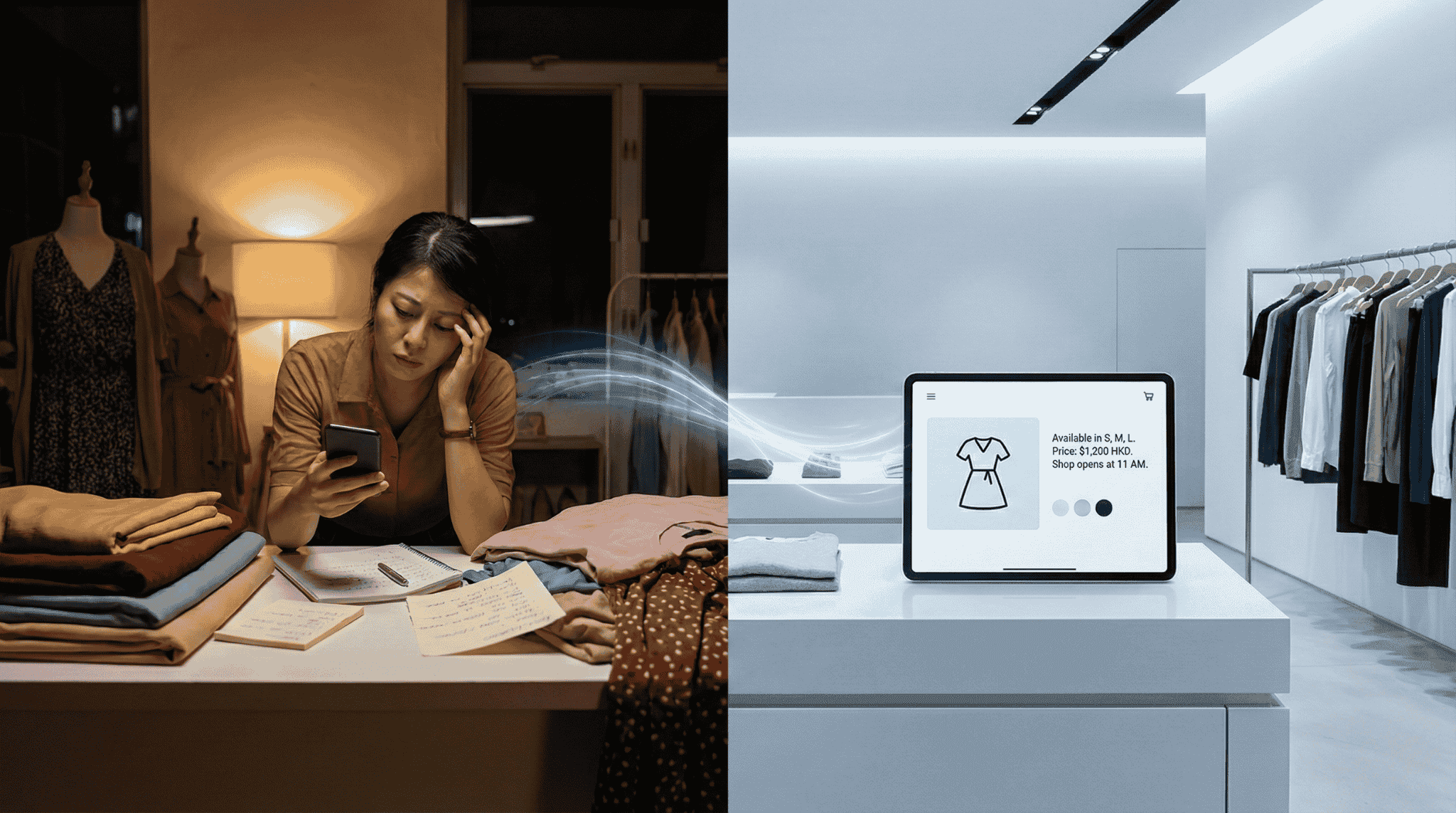
For small retail businesses, the browse-to-buy window is narrow. A customer sees something on Instagram, messages the shop on WhatsApp, and either gets an answer or moves on. When that message lands at 10 PM on a Tuesday, most boutiques miss it entirely.
This is how retail businesses are using AI customer service to capture leads that would otherwise disappear overnight — and what other shop owners can learn from the approach.
Why Do Retail Businesses Lose So Many After-Hours Leads?
Small retail shops increasingly rely on WhatsApp and Instagram for sales. Customers send photos, ask about sizes, check availability, and enquire about pricing — all through chat. It is personal, direct, and effective.
The challenge is timing. Instagram browsing peaks in the evening. Customers discover products, get interested, and reach out — often after the shop has closed. A message asking "Do you have this in size M?" at 9 PM might not get a reply until noon the next day.
According to a Harvard Business Review study, companies that respond within one hour are seven times more likely to qualify a lead. For a boutique selling items in the $50–$300 range, each missed conversation represents real revenue. A Drift study found that the odds of qualifying a lead drop 10 times after just a 5-minute delay — and most small retailers are not responding for 12+ hours.
What Types of Retail Customer Messages Can AI Handle?
For retail businesses, the most common after-hours enquiries are predictable and repetitive — exactly the type AI handles well.
Message Type | Example | What AI Does |
|---|---|---|
Stock availability (~35%) | "Do you have this in black?" "Is this still available in S?" | Checks the shop's uploaded inventory and gives a direct answer |
Pricing and promotions (~25%) | "How much is this?" "Is there a discount for buying two?" | Provides clear answers from the shop's pricing information |
Store information (~20%) | "Where are you located?" "What are your weekend hours?" | Answers basic logistics without needing a human |
Sizing guidance (~10%) | "I'm usually a UK 8, what size should I get?" | Provides the sizing guide if uploaded; flags for follow-up if not |
Custom or complex requests (~10%) | "Can you hold this for me?" "Do you do alterations?" | Acknowledges the request and flags it for human follow-up |
According to IBM, AI chatbots can handle up to 80% of routine customer enquiries without human intervention. For retail, where most after-hours messages are about stock, pricing, and hours, the coverage rate is typically even higher.
How Does AI Lead Capture Work for a Retail Business?
The AI assistant does not close sales — that still happens through personal interaction. What it does is keep the conversation warm and capture the lead before it goes cold.
Here is how the process works in practice:
9:15 PM — Customer messages: "Hey, do you have the linen blazer in medium?"
Without AI: The message sits unanswered until the shop opens. By morning, the customer has found an alternative or lost interest.
With AI: The assistant replies within seconds: "Yes, the linen blazer is available in medium. It is $120 and we also have it in navy and cream. Would you like us to hold one for you? Our team can confirm when we open at 10 AM."
The customer is engaged. Their details are captured. The shop owner starts the next day with a warm lead instead of a stale message.
Platforms like Omago, a WhatsApp AI assistant built for SMEs, make this setup straightforward. You upload your product information — inventory, pricing, sizing guides, store policies — and the AI starts responding to customer messages with accurate, specific answers.
What Results Can Retail Businesses Expect?
The impact for retail businesses typically shows up in three measurable areas:
Lead capture rate increases. No evening message goes unacknowledged. According to an Intercom study, 61% of customers prefer faster AI responses over waiting for a human agent. An immediate, helpful answer at 9 PM converts far better than silence until noon.
Response time drops from hours to seconds. According to HubSpot, 90% of customers rate an immediate response as important when they have a service question, with 60% defining "immediate" as 10 minutes or less. AI meets that expectation automatically.
The shop owner gets their evenings back. Instead of spending personal time answering repetitive stock questions, the owner reviews a summary of the night's conversations each morning and follows up only on what needs a personal touch.
What Should AI NOT Handle for Retail?
The honest trade-off: AI does not replicate the personal styling advice that makes boutique shopping special. Three areas still need a human:
Personal styling recommendations. "What would go with this skirt for a wedding?" requires taste, creativity, and relationship — not an automated response.
Negotiations and custom deals. Loyal customers who expect personalised pricing or bundle deals should be handled by the owner or team directly.
Complaints or returns. "The colour was different from the photo" needs empathy and a real solution, not an automated acknowledgment.
AI handles the logistical questions so the owner can focus their personal time on the conversations that actually need their expertise and taste.
What Are the Most Important Tips for Retailers Using AI?
Keep your inventory updated. The AI is only as helpful as the information it has. If your stock changes frequently, build a weekly habit of updating your product information. Outdated availability information erodes trust faster than no response at all.
Use it for lead qualification. Not every message is a serious buyer. AI can identify high-intent enquiries ("I want to buy this, what is the price?") versus casual browsing, helping you prioritise your follow-ups each morning.
Match your brand personality. Boutiques win on personal connection. Make sure your AI assistant's tone matches your brand — warm and approachable, not corporate or robotic. The assistant should feel like an extension of your shop's character.
Review conversations daily. Spend 5 minutes each morning reading through the previous night's conversations. Follow up on holds, sizing questions, and any message the AI flagged for human attention.
Frequently Asked Questions
Can AI really handle retail product questions accurately?
Yes, provided you upload current product information. AI pulls answers directly from your inventory data — stock levels, pricing, sizes, colours, and descriptions. According to IBM, AI can handle up to 80% of routine enquiries without human intervention. The key is keeping your product information up to date.
Will customers feel like they are talking to a robot?
Not if configured well. Modern AI assistants match your brand tone and provide specific, helpful answers — not generic scripts. An Intercom study found that 61% of customers prefer faster AI responses over waiting for a human, suggesting that helpfulness matters more than whether the response is automated.
How does AI capture leads for a retail business?
When a customer enquires about a product, the AI provides an immediate answer and collects their details — name, product interest, preferred size or colour. This information is queued for your team to follow up on personally when the shop opens. The lead is warm instead of cold.
What if my inventory changes every week?
AI platforms like Omago let you update your product information quickly — uploading a new document or updating a price list takes minutes. Build a weekly routine (for example, every Monday morning) to ensure the AI always has current information.
Is AI worth it for a small shop with low message volume?
If you receive fewer than 5 after-hours customer messages per week, a free WhatsApp away message is likely sufficient. AI starts paying for itself when you are regularly missing 10+ evening enquiries per week with products in a price range where even 2–3 additional conversions per month cover the cost of the tool.
Sources
Harvard Business Review — Companies responding within 1 hour are 7x more likely to qualify a lead
IBM — AI chatbots handle up to 80% of routine enquiries without human intervention
Drift — Lead qualification drops 10x after a 5-minute response delay
HubSpot — 90% of customers rate immediate response as important; 60% define "immediate" as ≤10 minutes (2024)
Intercom — 61% of customers prefer faster AI responses over waiting for a human agent (2024)
Related Articles
Business Tips
.
February 1, 2026
What Can AI Customer Service Actually Do for a Small Business?
What Can AI Customer Service Actually Do for a Small Business?
Omago Editorial
Business Tips
.
February 1, 2026
WhatsApp Auto-Reply for Small Business: What Actually Works in 2025
WhatsApp Auto-Reply for Small Business: What Actually Works in 2025
Omago Editorial
Contact Us
Ready to keep the
front door open?
Book a 15-minute demo. No credit card required.
See Omago in action with your own data.