
Business Tips
Omago Editorial
.
January 30, 2026
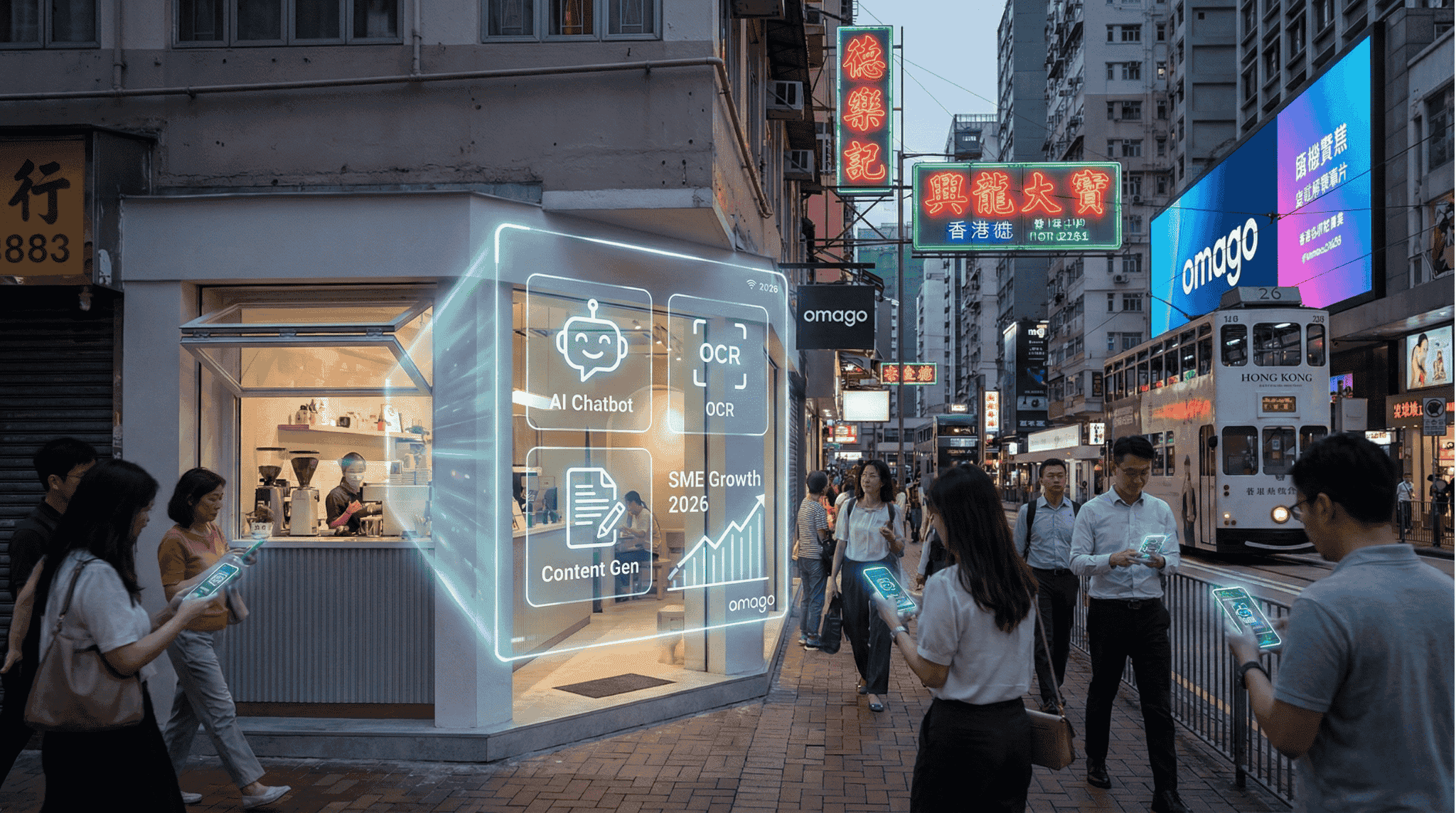
AI adoption among Hong Kong enterprises has reached near-universal levels. According to the HKPC's AI Readiness in Workplace Survey 2025, 88% of employees in surveyed firms are already using AI tools in their daily work — primarily in customer service, data analysis, and marketing. A further 92% of firms plan to introduce AI into additional workflows, with nearly a quarter expecting full implementation within a year.
But a gap persists. While large Hong Kong enterprises score "Mature" on digitalisation indices, SMEs remain at "Basic" (scoring 35.9 out of 100 on the HKPC Enterprise Digitalisation Index). The opportunity is clear. The question for most small business owners is where to start.
How Are Hong Kong SMEs Actually Using AI Today?
Based on the HKPC surveys and industry reports, the most common AI applications among local SMEs fall into five categories:
AI Application | Adoption Rate | Typical Use Case |
|---|---|---|
Customer service chatbots | ~20% of AI-adopting SMEs | Handling WhatsApp, Messenger, and web chat enquiries — especially after hours |
OCR and document processing | ~19% | Digitising receipts, invoices, business cards — popular in trading and logistics |
Text generation | ~14% | Marketing copy, social media posts, email drafts, product descriptions |
Image generation | ~12% | Product photography enhancement, social media visuals, marketing materials |
Document and presentation generation | Growing fastest | Proposals, reports, pitch decks — led by professional services firms |
Customer service chatbots are the most popular entry point because they solve an immediate, measurable problem: unanswered customer messages. Restaurants, retail shops, and service businesses lead adoption in this category.
What Separates SMEs That Succeed with AI from Those That Do Not?
SMEs that report positive AI outcomes share three common patterns:
They started with a specific problem. Not "let us adopt AI" but "we are losing customers because we cannot reply after hours" or "our team spends 10 hours a week writing the same emails." A defined problem leads to a measurable outcome.
They chose ready-made solutions. Custom AI development is expensive and slow. The SMEs seeing ROI fastest are using existing tools — SaaS platforms, API-based services, and plug-and-play solutions that require configuration, not coding. Platforms like Omago, a WhatsApp AI assistant built for SMEs, let businesses upload their information and go live within a day without any technical expertise.
They trained their teams. The HKPC survey found that AI became easier to use over the year, partly due to better technology and partly because staff became more comfortable with the tools. Investment in basic AI literacy pays dividends across the organisation.
What Is Holding Hong Kong SMEs Back from AI Adoption?
The barriers are consistent across industries and confirmed by multiple surveys:
High implementation costs. The HKPC survey identified cost pressures as particularly significant for SMEs with limited resources. Even modest monthly subscriptions need clear justification for businesses operating on thin margins.
Knowledge gaps. Many SME owners know AI exists but are unsure which tools are relevant, how to evaluate them, or how to implement them without disrupting existing operations. The HKPC found that a lack of AI expertise and training was among the top challenges cited by respondents.
Integration complexity. Off-the-shelf AI tools do not always integrate smoothly with existing systems. A restaurant might want AI for WhatsApp but finds it difficult to connect with their POS or booking system.
Trust. Letting AI respond to customers on your behalf requires trust in the technology. Many business owners worry about AI giving wrong answers or creating a poor customer experience. According to Zendesk, customer satisfaction with AI interactions has improved 15% year-over-year, but scepticism among business owners remains a real barrier to adoption.
Where Should a Hong Kong SME Start with AI?
For SMEs that have not yet adopted AI, the most practical entry points are ranked by impact and ease of implementation:
1. Customer service automation (highest impact, lowest risk). If you receive customer messages on WhatsApp or social media, an AI assistant that handles after-hours enquiries is the simplest starting point. It solves a real problem (missed messages) with measurable results (more responses, more conversions). According to IBM, AI chatbots can handle up to 80% of routine enquiries without human intervention.
2. Content assistance (moderate impact, very easy). If you produce marketing content — social media posts, email newsletters, product descriptions — AI writing tools can cut production time significantly. The output needs editing, but the first draft comes in seconds instead of hours.
3. Document processing (high impact for paper-heavy businesses). If your business handles paper invoices, receipts, or forms, OCR and document processing AI can eliminate hours of manual data entry. This is especially valuable for trading, logistics, and professional services.
What Government Support Is Available for Hong Kong SMEs Adopting AI?
The Hong Kong government offers several funding programmes for SME digital transformation. Important note: programme availability and terms change — always verify current status on the official government websites before applying.
Programme | What It Covers | Key Details |
|---|---|---|
Technology Voucher Programme (TVP) | Technology services and solutions to improve productivity | Covered up to 75% of approved project costs, cumulative ceiling of HK$600,000 per enterprise. Note: TVP ceased accepting new applications after 31 December 2024. Check the Innovation and Technology Commission website for any successor programmes. |
BUD Fund | Projects enhancing competitiveness including digital transformation | Up to HK$7 million per enterprise across approved markets |
Digital Transformation Support Pilot Programme | Digital solutions for SMEs | Operated by Cyberport with HK$500 million in government funding, offering matching funds |
These programmes specifically target the funding barrier that most SMEs cite as their primary obstacle. Even if specific programmes close, the Hong Kong government has consistently introduced new digital transformation support — check the HKPC and Innovation and Technology Commission websites for the latest options.
What Does the Future Look Like for AI Adoption Among Hong Kong SMEs?
The trajectory is clear. The HKPC survey found that 92% of firms plan to introduce AI into their workflows, with the government's latest Policy Address explicitly designating AI as a pillar industry for Hong Kong's future development.
The businesses that start now — even with simple applications like after-hours customer service — build the familiarity and infrastructure that makes future adoption easier. The question is not whether your business will use AI. It is whether you will start before or after your competitors do.
Frequently Asked Questions
What percentage of Hong Kong businesses are using AI?
According to the HKPC's AI Readiness in Workplace Survey 2025, 88% of employees in surveyed firms are already using AI tools in their daily work. The most common applications are customer service, data analysis, and marketing. A further 92% of firms plan to expand AI into additional workflows.
What is the easiest AI tool for a Hong Kong SME to start with?
Customer service chatbots are the most popular entry point, adopted by approximately 20% of AI-using SMEs. They solve an immediate problem (unanswered messages), require no coding, and produce measurable results within the first week. Platforms like Omago let you upload your business information and go live on WhatsApp the same day.
How much does AI cost for a small business in Hong Kong?
Costs vary widely. AI writing tools like ChatGPT start from free tiers. Customer service AI platforms typically cost HK$200–HK$2,000 per month depending on features and message volume. The HKPC survey found that the average cumulative AI investment among adopting firms was approximately HK$830,000, though most SMEs start with far smaller amounts.
Is the Technology Voucher Programme (TVP) still available?
The TVP ceased accepting new applications after 31 December 2024. However, the Hong Kong government regularly introduces new digital transformation support programmes. Check the Innovation and Technology Commission website and the HKPC for current funding options, including the BUD Fund and Cyberport's Digital Transformation Support Pilot Programme.
What are the biggest barriers to AI adoption for Hong Kong SMEs?
According to the HKPC survey, the top challenges are a lack of AI expertise and training, data privacy and security concerns, integration difficulties with existing systems, employee resistance to change, and high implementation costs — with cost pressures being particularly significant for SMEs with limited resources.
Sources
HKPC AI Readiness in Workplace Survey 2025 — 88% of employees using AI; 92% of firms plan to expand AI adoption; talent shortage is top barrier (Survey of ~800 Hong Kong companies, September 2025)
HKPC Enterprise Digitalisation Index Survey — Overall Hong Kong enterprise digitalisation score of 35.9 ("Basic" level); 30% of enterprises using AI in operations (Survey of 508 enterprises, 2023)
HKPC / HKU Hong Kong AI Industry Development Study — Average cumulative AI investment of HK$830,000; 59% of AI-adopting firms plan to expand usage (216 AI-related enterprises, 2023)
IBM — AI chatbots handle up to 80% of routine enquiries without human intervention
Zendesk — Customer satisfaction with AI interactions improved 15% year-over-year (2024)
Innovation and Technology Commission — TVP ceased accepting applications after 31 December 2024; cumulative ceiling was HK$600,000 per enterprise at 75% funding ratio
Related Articles
Business Tips
.
February 1, 2026
What Can AI Customer Service Actually Do for a Small Business?
What Can AI Customer Service Actually Do for a Small Business?
Omago Editorial
Business Tips
.
February 1, 2026
WhatsApp Auto-Reply for Small Business: What Actually Works in 2025
WhatsApp Auto-Reply for Small Business: What Actually Works in 2025
Omago Editorial
Contact Us
Ready to keep the
front door open?
Book a 15-minute demo. No credit card required.
See Omago in action with your own data.