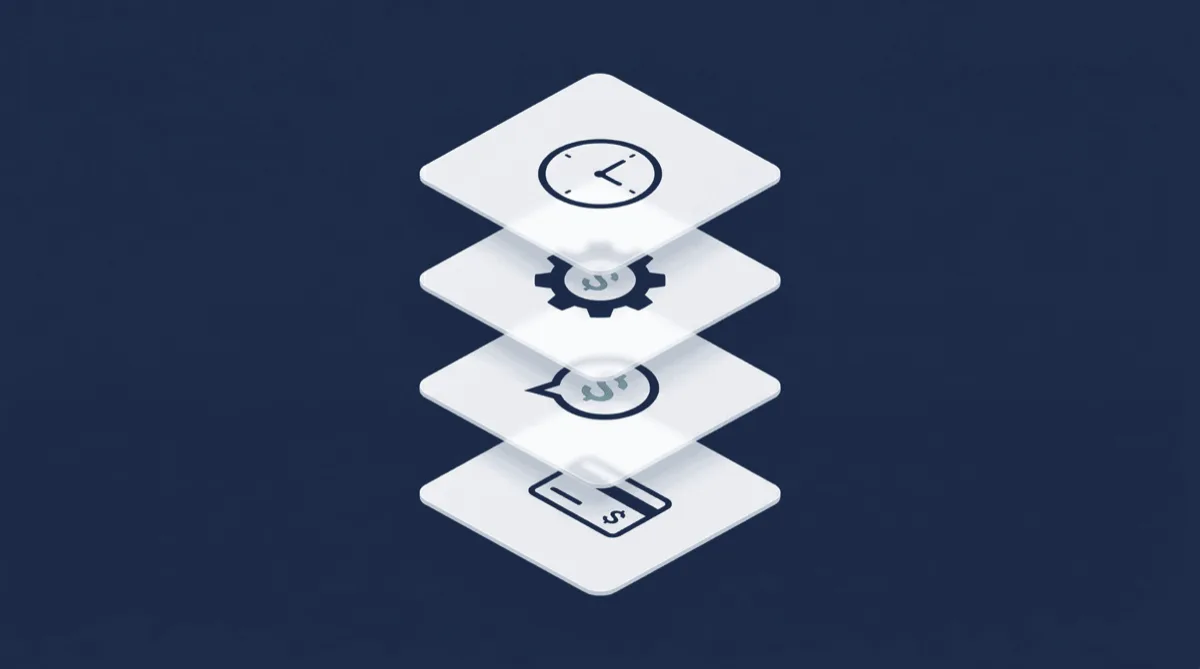
The price on the vendor's pricing page is not the price you will pay. Every AI agent deployment for a small business involves four cost layers, and most businesses only model the first one before signing up.
This guide breaks down all four layers with real numbers, explains how WhatsApp's per-message pricing interacts with your AI automation, and provides a cost model template you can fill in with your own numbers to get an accurate monthly estimate.
The Four Cost Layers Most SMEs Miss
Layer 1: Platform Subscription (Fixed Monthly)
This is the only cost most SMEs model. Platform subscriptions range from free to $369/month for SME-focused tools.
| Platform | Entry | Mid-Tier | Model |
|---|---|---|---|
| Omago | Free (50 msgs) | $99/mo (8,000 msgs) | Flat-rate, message-based tiers |
| ManyChat | Free (1,000 contacts) | $15–$39/mo | Contact-based scaling |
| respond.io | $79/mo | $159–$279/mo | Monthly Active Contact tiers + overage |
| Intercom | $29/mo base | $29/mo + $0.99/outcome | Subscription + per-resolution AI |
Layer 2: Messaging Channel Fees (Variable)
WhatsApp Business Platform charges per delivered template message. Since July 2025, the pricing is per-message (not per-conversation), with four categories.
The critical insight for AI customer service: When a customer messages you first, a 24-hour service window opens. Your free-form responses within that window are free for the first 1,000 per business phone number each month; from 1 October 2026, replies beyond that — and utility templates sent inside the window — are billed per message at the market's utility rate. This means AI agents responding to inbound customer queries generate modest WhatsApp fees.
The expensive scenario is outbound marketing messages. A promotional blast to 1,000 customers at $0.05–$0.08 per message costs $50–$80 — a meaningful expense for a small business.
Telegram and website chat have zero per-message fees.
Layer 3: Usage-Based AI Charges (Variable)
Some platforms charge per AI resolution on top of the subscription. Intercom's Fin AI Agent costs $0.99 per outcome. At 100 resolutions per month, that is $99 on top of the base subscription. At 500, it is $495.
Flat-rate platforms like Omago and Tidio include AI within the message or conversation quota — no additional per-resolution charge. This makes costs predictable but means you need to choose a plan with sufficient message headroom.
Layer 4: Your Internal Time (Hidden but Real)
The OECD reports that only 23.6% of SMEs using generative AI have employees participating in AI-related training, and only 28.6% have implemented staff guidelines. This under-investment in setup and governance drives the "lack of immediate results" that 32% of Hong Kong enterprises cite as a top AI underperformance cause, according to the Deloitte-HKU AI Adoption Index 2026.
Budget realistically: 2–4 hours for initial setup and configuration. 15–30 minutes per week for knowledge base maintenance. 1–2 hours for staff training on the handoff process. Periodic review of AI conversation logs (30 minutes per week recommended).
How to Build Your Monthly Cost Model
Fill in your own numbers:
| Cost Component | Your Estimate | Notes |
|---|---|---|
| Platform subscription | $____/month | Fixed; choose based on expected message volume |
| WhatsApp per-message fees | $____/month | Inbound service free up to 1,000 replies/month, then billed per message; budget for occasional outbound |
| Per-outcome AI charges (if applicable) | $____/month | Only some platforms; multiply expected resolutions × rate |
| Overage charges | $____/month | Budget 10–20% buffer above plan limit |
| Your time: setup (month 1 only) | ____ hours | 2–4 hours typical; or managed setup fee |
| Your time: ongoing maintenance | ____ hours/month | 2–4 hours/month typical |
| Estimated total monthly cost | $____ |
Example: A retail shop on a flat-rate plan ($99/month tier)
| Component | Amount |
|---|---|
| Platform subscription (e.g., Omago Plus, Tidio Communicator, or respond.io Starter) | $79–$99/month |
| WhatsApp fees (inbound service replies under the 1,000/month free allowance) | ~$10/month |
| Per-outcome charges | $0 on flat-rate plans |
| Overage buffer | ~$20/month |
| Internal time (~3 hours/month) | Not billed but real |
| Estimated total | ~$110–$130/month |
Compare this to the cost of one part-time evening staff member ($15–$25/hour x 20 hours/month = $300–$500/month) and the value proposition becomes clear. ManyChat reports a La Repa (fashion brand) campaign that exceeded its projected sales target by nearly 300% during Black Friday, reaching about $85,000 in sales — illustrating the revenue potential when messaging costs are managed well.
What Drives Unexpected Cost Increases?
Three patterns cause "bill shock" for SMEs.
Outbound marketing volume. WhatsApp marketing messages cost roughly 3–7x more than service messages, depending on the market. If your AI platform sends promotional templates (order reminders, upsells, re-engagement campaigns), each one incurs a per-message charge. Design workflows to prioritise responses within service windows, where free-form replies are free up to 1,000 a month.
Contact or seat scaling. Platforms that price by contacts (ManyChat) or Monthly Active Contacts (respond.io) can see costs climb as your audience grows — even if message volume stays stable. respond.io charges $12–$15 per 100 additional MACs beyond your plan's limit.
Per-outcome pricing at scale. Intercom's $0.99 per resolution is reasonable at low volume but becomes the dominant cost at high volume. At 300 resolutions per month, AI charges alone are $297 — potentially more than triple the cost of a flat-rate plan from Omago, Tidio, or similar platforms.
How to Control Costs Without Reducing Effectiveness
Prioritise inbound over outbound. An AI agent that responds to customer-initiated messages generates low WhatsApp fees (the first 1,000 service replies a month are free) while delivering immediate value. Outbound campaigns should be selective and targeted — not automated blasts.
Use conversation flows to reduce message count. A well-designed conversation flow that qualifies a lead in 4 structured exchanges is cheaper and more effective than an open-ended AI conversation that takes 12 messages to reach the same outcome.
Monitor usage weekly, not monthly. Most platforms provide real-time usage dashboards. Check weekly and upgrade proactively if you are approaching your limit — overage rates are always higher than in-plan rates.
Start with a free tier. Every major platform offers a free or trial tier. Use it. Validate the AI's accuracy and estimate your actual message volume before committing to a paid plan.
Frequently Asked Questions
What is the cheapest way to test AI customer service?
Start with a free plan that includes a website chat widget. Omago's Free plan includes 50 messages/month — enough to test with real customer queries for 2–3 weeks. ManyChat offers a free tier for up to 1,000 contacts. respond.io offers a 7-day free trial. Tidio offers a free plan with up to 50 live chat conversations. Use these to validate before paying anything.
Why is WhatsApp not free for businesses?
WhatsApp consumer messaging is free. WhatsApp Business Platform (the API that AI agent platforms use) charges per delivered template message because it provides infrastructure: delivery tracking, message categorisation, automated flows, and business verification. The key saving: replies to customer-initiated messages within the 24-hour window are free for the first 1,000 per number each month (from 1 October 2026; replies beyond that are billed per message). Design your AI to respond to inbound messages and the WhatsApp cost stays minimal.
Is flat-rate or per-outcome pricing better for SMEs?
Flat-rate is almost always better for growing businesses. Per-outcome pricing seems cheap at low volume but becomes unpredictable as your AI handles more conversations. A flat-rate plan lets you budget with confidence. The only exception is a very low-volume business (fewer than 30 AI resolutions per month) where per-outcome might be marginally cheaper.
How much should I budget for the first 90 days?
For a typical SME starting with one channel: plan for 3 months at your chosen platform tier plus a 20% buffer for overages or add-ons. For a mid-tier plan ($79–$99/month on platforms like Omago, respond.io, or Tidio), that is approximately $280–$360 for the first 90 days — less than one month of part-time staffing costs — to validate whether AI customer service generates positive ROI for your business.
What is the most commonly underestimated cost?
Internal time for knowledge base maintenance. The AI is only as accurate as the information you provide. If you update prices, hours, products, or policies and do not update the AI's knowledge base, it gives wrong answers — which costs more in customer trust than the tool saves in efficiency. Budget 15–30 minutes per week.
Sources: OECD "Generative AI and the SME Workforce" (2025), Deloitte–HKU AI Adoption Index 2026, WhatsApp Business Platform pricing (2026, checked 2026-10-05), ManyChat pricing, respond.io pricing, Intercom pricing, ManyChat — La Repa WhatsApp case study.