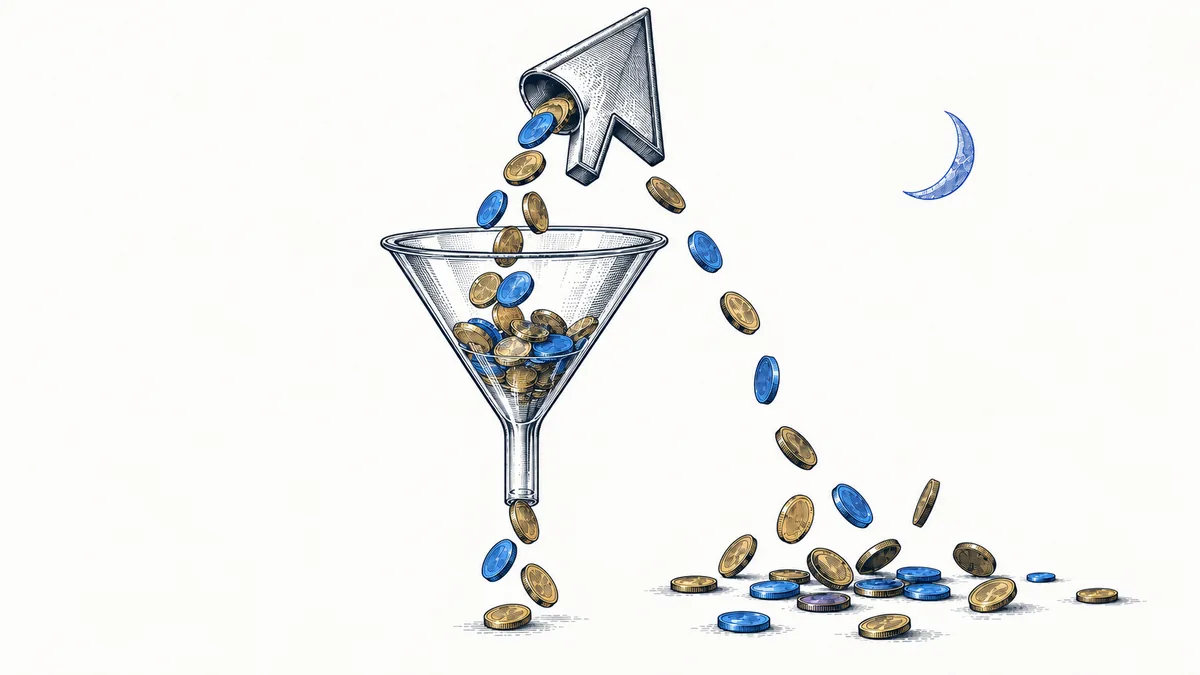
Start with the uncomfortable part: there is no official Hong Kong cost-per-lead benchmark. No government series, no audited industry table, nothing you can point at in a board meeting. What exists is agency composites — one Hong Kong agency puts Facebook CPC at HK$5-18 and cost per lead for service businesses at HK$55-280 (Pix-Vu, 2026) — plus global figures that are directionally useful and locally imprecise. Meanwhile Hong Kong advertisers spent HK$33.9 billion in 2025 and are spending again, up 12% year on year in January-February 2026 (admanGo, 2026). So the money is real, the benchmark is not, and the only cost per lead that governs your business is the one you calculate yourself.
This article covers what the published Hong Kong benchmarks actually say and how far to trust them, how to compute your own CPL in about ten minutes, what Meta's own data says about click-to-WhatsApp ads versus other lead formats, and the part most advertisers never price: what happens to a paid lead that arrives at 9pm on a Sunday.
What does a click-to-WhatsApp lead cost in Hong Kong?
The honest answer is a band, not a number: Hong Kong agency benchmarks put cost per lead for service businesses at HK$55-280, with clicks running HK$5-18 (Pix-Vu, 2026). Those are agency composites from live client accounts, not audited or government data, so treat them as a sanity check on your own numbers rather than a target.
Within that band, the spread is driven by category rather than by cleverness. The same Hong Kong agency benchmark puts financial services at the low end of the CPC range (roughly HK$5-8) and luxury retail at the premium end (up to HK$18), with ecommerce cost per lead landing 30-50% below service businesses — roughly HK$28-195 (Pix-Vu, 2026). A second Hong Kong agency notes that CPMs "commonly land in the tens of Hong Kong dollars," that meaningful testing is difficult below HK$200-300 per day per campaign, and that most owner-run accounts run HK$10,000-50,000 per month in media spend (Kick Ads, 2026). One Hong Kong PPC practitioner adds the direction of travel: beauty keywords that cost HK$8-12 per click two years ago now clear higher (Velizara Tellalyan, 2026).
The global figures bound the Hong Kong numbers rather than replace them. WordStream's 2025 Facebook benchmark, across roughly 1,800 campaigns, reports US$1.92 average CPC, 7.72% conversion rate and US$27.66 cost per lead — about HK$216 at 7.8 (WordStream, 2025, updated 14 September 2026). On search, average Google Ads CPC was US$5.26 in 2025 (about HK$41), with dental at US$7.85 and education at US$6.23, across 13,474 US campaigns (WordStream/LocaliQ, 2025). One European analysis puts cost per click-to-WhatsApp opt-in at EUR 0.40-2.00 versus EUR 3-8 for standard lead ads (Kanal, 2026) — heavily EU-weighted, so directional only.
| Row | Metric | Figure | Source (year) | Label |
|---|---|---|---|---|
| HK, all verticals | Facebook CPC | HK$5-18 | Pix-Vu (2026) | Agency benchmark |
| HK, service businesses | Cost per lead | HK$55-280 | Pix-Vu (2026) | Agency benchmark |
| HK, ecommerce | Cost per lead | 30-50% below service (approx. HK$28-195) | Pix-Vu (2026) | Agency benchmark |
| HK, financial services | CPC | Low end, approx. HK$5-8 | Pix-Vu (2026) | Agency benchmark |
| HK, luxury retail | CPC | Premium end, up to HK$18 | Pix-Vu (2026) | Agency benchmark |
| Global, Facebook lead gen | CPC / CVR / CPL | US$1.92 / 7.72% / US$27.66 (approx. HK$216) | WordStream (2025) | Directional, non-HK |
| Global, education | Cost per lead | US$14.72-29.61 (approx. HK$115-231) | Superads (2026) | Directional, non-HK |
| Global, Google Search all-industry | CPC | US$5.26 (approx. HK$41) | WordStream/LocaliQ (2025) | Directional, non-HK |
| Global, click-to-WhatsApp | Cost per opt-in | EUR 0.40-2.00 (approx. HK$3.40-17) | Kanal (2026) | Directional, EU-weighted |
Conversions at US$1 to HK$7.8 and EUR 1 to HK$8.5, checked 2026-09-21. Read the table as an order-of-magnitude guide. If your service-business CPL is HK$900, something specific is broken — targeting, creative, or the thing we get to below. If it is HK$180, you are inside a normal Hong Kong band and your gains will come from what happens after the message arrives.
How do I calculate my own cost per lead?
Divide total ad spend for the period by the number of valid enquiries it produced. That is the whole formula, and it beats every benchmark on this page because it is the only one measured on your traffic, your offer and your city.
The work is in the word "valid." Meta will report results, clicks, and "messaging conversations started," and none of those are leads. A lead is a person who opened a conversation, is in your service area, wants something you actually sell, and left enough for you to follow up. Wrong-number taps, people asking for a franchise, students doing a project and bots do not count. Define it once, in writing, then count it the same way every month — a CPL that drifts because the definition drifted tells you nothing.
Here is the arithmetic on a worked example. Say you spend HK$20,000 in a month on click-to-WhatsApp ads and buy roughly 1,667 clicks at HK$12. Of those, 140 people send a first message; on review, 96 are genuine enquiries for a service you offer. Your cost per lead is HK$20,000 divided by 96, or HK$208 — inside the Hong Kong service-business band. Now the second calculation, which almost nobody runs: of those 96, suppose 30 arrived after 7pm or at the weekend, and 18 of them got no reply until the next working day. If half of those go cold, you did not buy 96 leads. You bought 87 workable ones, and your true cost per lead is HK$230 — an 11% increase you paid for with money already spent.
Do it like this, monthly, in a spreadsheet that takes ten minutes:
- Spend. Total media spend for the period, from Ads Manager, including any agency management fee if you want a fully loaded number (Hong Kong agencies charge HK$18,000-75,000 per month plus 10-20% of media spend, per Pix-Vu, 2026).
- Enquiries. Count first-time inbound conversations, not clicks.
- Valid enquiries. Subtract the junk, using your written definition.
- CPL. Spend divided by valid enquiries.
- Answered CPL. Spend divided by valid enquiries that got a reply while the person was still paying attention — say within an hour.
- Cost per booking. Spend divided by appointments actually booked. This is the number that should drive budget decisions.
The gap between step 4 and step 5 is the number this article is really about. It is invisible in Ads Manager, it is usually larger than any optimisation you were planning, and it costs nothing to close.
Are click-to-WhatsApp ads cheaper than lead forms?
On Meta's own aggregate data, yes — with the caveat that the comparison is against conversation-optimised ads rather than every format. Meta reports that "ads that click to WhatsApp optimizing for leads drove 24% lower cost per lead compared to ads optimizing for conversations," from an experiment covering 116,000 campaigns across 43,000 businesses between 4 and 10 November 2024 (Meta/WhatsApp Business, 2024). That is the largest sample in this space and it comes from the platform running the auction.
Two more Meta-published figures point the same way. Businesses selecting multiple message destinations rather than one "achieved a 9% lower cost per message and an 11% higher conversion rate" (Meta for Business). And the format is growing fast enough that Meta calls it out on earnings calls: CFO Susan Li said on the Q3 2025 call (29 October 2025) that business messaging "grew revenue 60% year over year in Q3" on the back of click-to-WhatsApp ads.
The case studies are more interesting and less reliable. The closest thing to an Asia-Pacific example is Confer On in Indonesia, which reported 3.9 times more purchases and 79% lower cost per purchase from click-to-WhatsApp ads optimised for purchases through messaging, against conversation-optimised ads (Meta/WhatsApp Business, 2026). Braip in Brazil reported 45% more qualified leads and 30% lower cost per lead with lead optimisation, over a campaign running 13-26 March 2025 (Meta/WhatsApp Business). Every one of these carries Meta's standard disclaimer that results are self-reported and not guaranteed. No Meta case study with hard Hong Kong numbers is published, so nobody — including your agency — can honestly quote you a local uplift figure.
There is a mechanical reason the format works in Hong Kong beyond the auction. A conversation started from a click-to-WhatsApp ad and answered inside 24 hours opens a free entry point window under Meta's pricing — one that may now remain open for up to 7 days (Meta pricing documentation) — and service replies were free and unlimited from 1 November 2024. That changed on 1 October 2026: only the first 1,000 service messages per business number each month are now free, and service replies beyond that, plus in-window utility messages, are billable at the utility rate — about HK$0.20 per message in Hong Kong, after Meta raised local utility and authentication rates to US$0.026 on 1 July 2026 (UD.com.hk reading Meta's rate card, 2026). Even after that change, an inbound-first setup is on the cheap side of the rate card; the expensive models are broadcast-heavy ones. If you want the full rate-card picture, the WhatsApp Business API pricing breakdown by country has it market by market.
What are Hong Kong advertisers actually paying into?
Total Hong Kong ad spend was HK$33.9 billion in 2025, a 3% decline year on year, and the market has turned: January-February 2026 came in at HK$5.6 billion, up 12%, and Q2 2026 at HK$8.77 billion, up 5% (admanGo, 2026). The money coming back is going to the same place your leads come from.
Social is now the top channel. In Q2 2026 Instagram passed HK$1.04 billion in Hong Kong ad spend (up 18%) and Facebook HK$1.03 billion (up 16%); across full-year 2025 Facebook took HK$3.68 billion (up 0.3%) and Instagram HK$3.5 billion, up 35% year on year (admanGo, 2026). The names at the top of the spender list are HSBC, Hang Seng Bank and Standard Chartered — which matters to a clinic or a tutoring centre, because those are the budgets setting the auction price for the attention you are also buying.
Two practical implications. First, rising competition on Meta placements means your CPC drifts up whether or not your account changes, so measuring CPL monthly is a defensive habit, not a vanity metric. Second, when media costs rise, the cheapest available improvement is never a new creative — it is converting a higher share of the leads you already paid for.
Why do after-hours click-to-WhatsApp leads die?
Because the customer's clock starts the moment they hit send, and yours starts when someone opens the phone the next morning. A message that arrives at 6pm on Friday is roughly 60 hours old by Monday — and the evidence on what happens in that window is unusually consistent across two decades of studies.
Expectations first. EZ Texting's 2026 Consumer Texting Behavior Report (959 US consumers, released 14 April 2026) found 70% expect a business reply within one hour of sending a message, and that 72% read business texts within five minutes while 82% reply within fifteen. Zendesk's CX Trends 2026 (11,297 respondents across 22 countries, released 18 November 2025) found 74% of consumers now expect service to be available 24/7 and 88% expect faster responses than a year ago. HubSpot's research across 1,000 consumers in the US, UK, Australia and Singapore found 82% rate an immediate response as important or very important for sales enquiries, rising to 90% for support — and defines "immediate" as ten minutes or less.
Then the decay. Harvard Business Review's audit of 2,241 US firms found an average first response of 42 hours, with 37% replying within an hour, 24% taking more than 24 hours and 23% never replying at all; firms contacting within an hour were about seven times more likely to qualify the lead than those waiting an hour longer, and more than 60 times more likely than those waiting a day (Oldroyd, McElheran and Elkington, HBR, 2011). The famous "100 times more likely to connect, 21 times more likely to qualify" figures come from the 2007 MIT/InsideSales Lead Response Management study of six companies — frequently misattributed to HBR, and an odds ratio from a small vendor dataset, so treat the direction as sound and the magnitude as illustrative. The behaviour has not improved: RevenueHero's 2024 mystery-shop of 1,000 B2B companies found 63.5% never responded at all, with an average response of about 29 hours.
Now the share that lands outside office hours, which is the part specific to paid messaging. Salesloft/Drift's analysis of more than 30 million conversations found 39% happen outside 9 to 5, and 41% of meetings are booked outside 9 to 5 (Salesloft/Drift, 2024). BrightLocal's first-party study of 45,264 local business listings found restaurants receive 51% of phone calls after 5pm, and locksmiths 34% after 5pm plus 8% before 9am; Ruby Receptionists estimates 35-45% of calls to service businesses fall outside 9 to 5, while Hyro's analysis of 300,000 patient calls puts healthcare nearer 11% off-hours. The honest reading: the after-hours share varies roughly five-fold by category, so measure your own rather than quoting a single number. The full set of studies, with sample sizes and funding disclosures, is compiled in lead response time statistics for 2026.
WhatsApp is more forgiving than a phone call — the message sits there waiting for you — but the customer does not. They message the next clinic while they wait.
What is one unanswered Hong Kong enquiry worth?
Enough that the arithmetic stops being about software. Hong Kong ticket sizes in the verticals that advertise hardest are high: aesthetic treatments run from HK$2,000-8,000 a session for pico laser up to a quoted HK$53,888 for Thermage FLX; a single dental implant is HK$15,000-35,000 and a standard Invisalign course HK$38,000-58,000; tutoring group tuition averages about HK$240 an hour with monthly packages commonly HK$2,000-8,000; full-service immigration cases run into the tens of thousands (HK clinic and centre price lists, 2025-26).
Apply directional close rates — consultation-to-treatment of 50-70% in aesthetics against roughly 20% lead-to-consultation industry-wide, lead-to-patient near 24-30% in dental, lead-to-enrolment of 15-25% in tutoring, consultation-to-client around 30% in immigration (industry benchmarks, all non-HK and directional) — and the implied revenue of a single enquiry lands somewhere between a few hundred dollars for a tutoring lead and tens of thousands for an immigration case. Set that against a CPL of HK$55-280 and the conclusion is blunt: the enquiry you already paid for is worth many times the click, and losing it after hours is the single most expensive thing happening in the account. The vertical-by-vertical version of this arithmetic is in the cost of one unanswered enquiry in Hong Kong by industry.
How do you stop paying for clicks that never get answered?
Answer within minutes, every hour of the week, without adding headcount you cannot justify. There are only three ways to do that, and they cost very different amounts.
Hire coverage. A fully loaded customer service hire in Hong Kong runs roughly HK$269,000-290,000 a year for a day shift alone, and HK$342,000-363,000 once you add part-time evening and weekend cover; true round-the-clock human coverage needs four to five people. The full build-up — C&SD wage data, MPF, statutory leave, recruitment and turnover — is in what a customer service hire costs in Hong Kong versus an AI agent.
Auto-reply. Free, and it buys you almost nothing. A canned "we have received your message" does not answer the price question that made the person message you, and the customer treats it as confirmation that nobody is home.
An AI agent that answers, qualifies and books. This is the category that closes the specific gap between step 4 and step 5 in the CPL calculation above: a real answer to the actual question, in the customer's language, at the moment the ad delivered them. Omago is one option here — it sits on the website and WhatsApp, answers from your own content in any language, qualifies the enquiry and books the appointment, at a flat US$49-99 per month rather than per resolution or per seat (pricing checked 2026-09-21). SleekFlow, WATI, Omnichat, respond.io and imBee all serve this market too, with deeper broadcast and team-inbox tooling and, in several cases, longer track records in Hong Kong; the honest comparison of what each is good at is on the Omago versus SleekFlow comparison and in the pricing page.
Whatever you choose, judge it on one number: cost per booked appointment, before and after. If your answered-lead share rises and your cost per booking falls, the tool paid for itself; if not, it did not.
If you want to see what an AI agent would say to your own after-hours enquiries, paste your URL on the Omago home page and ask it the question your customers actually ask at 11pm.
Frequently asked questions
Is there an official cost-per-lead benchmark for Hong Kong?
No. There is no Hong Kong government series and no audited industry table for CPC or CPL by vertical. The available Hong Kong figures — Facebook CPC of HK$5-18 and service-business CPL of HK$55-280 — are agency composites (Pix-Vu, 2026), and the widely quoted global numbers such as US$27.66 average Facebook CPL (WordStream, 2025) are non-Hong Kong and directional. Use them as a sanity check, and compute your own CPL as ad spend divided by valid enquiries.
Are click-to-WhatsApp ads cheaper than Meta lead forms?
Meta's own aggregate experiment across 116,000 campaigns and 43,000 businesses found that click-to-WhatsApp ads optimised for leads drove 24% lower cost per lead than ads optimised for conversations (Meta/WhatsApp Business, 2024). Individual case studies report larger gains — 30% lower CPL for Braip in Brazil, 79% lower cost per purchase for Confer On in Indonesia — but all are self-reported and carry Meta's no-guarantee disclaimer, and none are from Hong Kong.
What share of my WhatsApp enquiries will arrive after hours?
It depends heavily on your category, so measure it rather than assume. Published figures range from about 11% off-hours for healthcare calls (Hyro, 300,000 calls) to 35-45% for service businesses (Ruby Receptionists) to 51% of restaurant calls after 5pm (BrightLocal, 45,264 listings), with 39% of business conversations happening outside 9 to 5 across more than 30 million conversations (Salesloft/Drift, 2024). Tag every enquiry with its arrival hour for one month and you will have your own number.
Does replying to a click-to-WhatsApp ad conversation cost money?
Mostly no: a conversation opened from a click-to-WhatsApp ad and answered within 24 hours opens a free entry point window of up to 7 days, and user-initiated service messages were free and unlimited from 1 November 2024. From 1 October 2026 only the first 1,000 service messages per business number each month are free; service replies beyond that and in-window utility messages are billable at the utility rate — roughly HK$0.20 per message in Hong Kong after the 1 July 2026 increase to US$0.026. Inbound-first setups stay on the cheap side of that rate card; broadcast-heavy ones do not.
What is the fastest way to lower my cost per booked appointment?
Answer faster, before you touch targeting or creative. Firms responding within an hour were about seven times more likely to qualify a lead than those responding an hour later, and more than 60 times more likely than those waiting a day (HBR, 2011), while 70% of consumers expect a reply within an hour (EZ Texting, 2026). If a meaningful share of your leads arrive in the evening or at weekends, closing that window converts leads you have already bought — which is cheaper than buying more.
Sources: Pix-Vu (2026), Kick Ads (2026), Velizara Tellalyan (2026), admanGo (2026), Meta/WhatsApp Business (2024, 2026), Meta for Business, Meta Q3 2025 earnings call (Susan Li, 2025), Meta pricing documentation and rate card effective 1 October 2026 (checked 2026-10-05), UD.com.hk (2026), WordStream/LocaliQ (2025), Superads (2026), Kanal (2026), Harvard Business Review — Oldroyd, McElheran and Elkington (2011), MIT/InsideSales Lead Response Management (2007), RevenueHero (2024), Salesloft/Drift (2024), BrightLocal (2024), Ruby Receptionists, Hyro, EZ Texting (2026), Zendesk CX Trends 2026 (2025), HubSpot Research, Hong Kong clinic and tutoring centre price lists (2025-26). Hong Kong CPC and CPL figures are agency benchmarks, not audited data; non-Hong Kong figures are directional. Currency converted at US$1 to HK$7.8 and EUR 1 to HK$8.5, checked 2026-09-21. General business information, not financial advice.