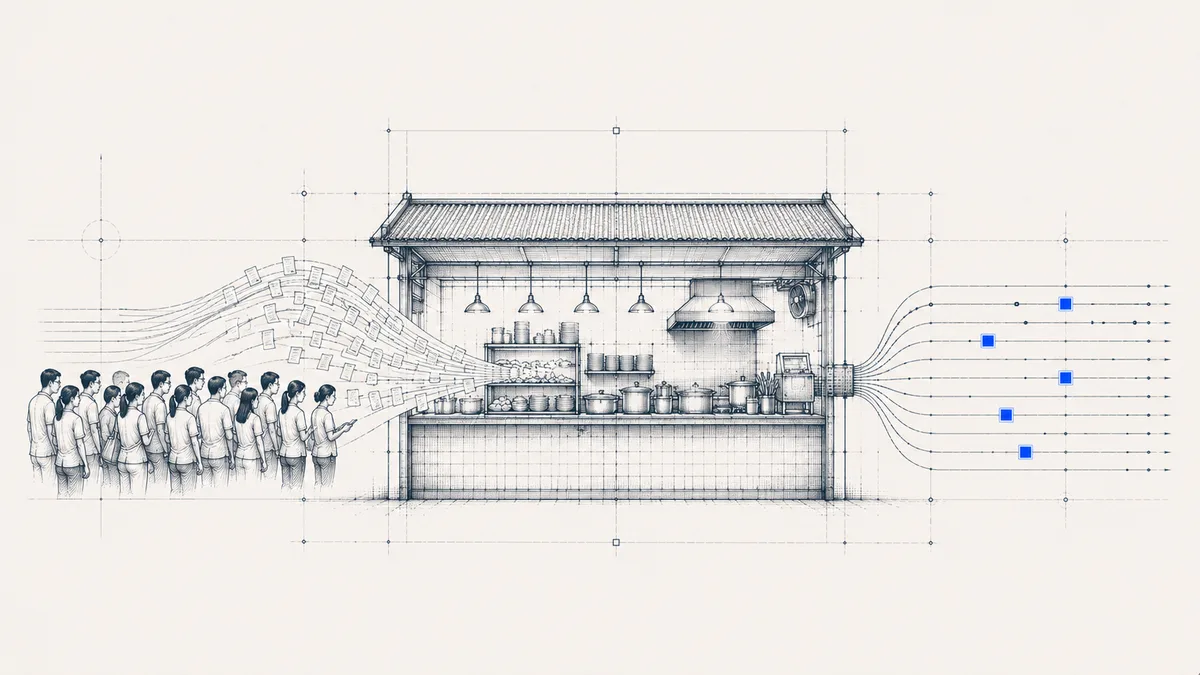
Singapore lost 3,047 food and beverage outlets in 2024 — the highest number of closures since 2005, according to MTI figures cited by Mothership in 2025. If you run an F&B or retail business here, an AI agent can't fix your rent, but it can take the repetitive customer chats off your floor staff so you stop bleeding labor on questions a machine should answer. This guide walks through exactly which tasks to automate, which to route to a human, and how the Singapore labor crunch changes the math.
Why are Singapore F&B and retail businesses turning to AI customer service?
Because labor is scarce, capped by policy, and expensive — and customer service eats hours your team doesn't have. Singapore averaged 75,900 job vacancies in 2025, with 1.58 vacancies for every job seeker, according to the Ministry of Manpower's Job Vacancies Report 2025 (released March 2026). That's a market where you simply cannot hire your way out of the problem.
The squeeze is structural, not seasonal. The services sector — which covers both F&B and retail — runs under a Dependency Ratio Ceiling of 35%, meaning Work Permit and S Pass foreign workers can't exceed 35% of your total headcount, with an S Pass sub-cap of just 10% (Ministry of Manpower, 2026). That's the most restrictive ceiling of any sector. On top of that, the S Pass levy was standardized at S$650 per month from 1 September 2025, and the Local Qualifying Salary rises to S$1,800 per month from 1 July 2026.
So the foreign-labor headroom is capped by law and getting pricier, while locals are scarce. The Restaurant Association of Singapore has stated that around 35% of the total F&B workforce are foreigners, mostly from Malaysia and China, and that F&B salaries rose by up to 20% on average over a two-year stretch (RAS via NTU, c. 2022). In retail, an NTUC LearningHub report found 93% of retail employees agree there's a manpower shortage — 48% somewhat agree and 45% strongly agree — and 44% intend to leave the sector within a year (NTUC LearningHub, 2022). When nearly half your retail floor is planning an exit, every shift you can cover with automation instead of a body you can't hire is a shift you keep open.
Put those numbers next to the broader vacancy picture and the squeeze is plain. December 2025 carried a 3.1% job vacancy rate, well above the 2000–2019 quarterly average of 2.3% (Ministry of Manpower, 2025), which means the tightness isn't a post-pandemic blip that's about to ease — it's the new baseline. Automating repetitive customer service is one of the few cost levers an SME owner here genuinely controls, precisely because the others — rent, headcount, levies — are either fixed by the landlord or fixed by policy.
What F&B and retail customer service tasks can an AI agent safely automate?
Routine, rule-based, high-volume tasks — reservations, order-taking, FAQs, stock checks, and order-status updates — are all safe to automate today. These are the conversations that happen hundreds of times a week and follow the same script every time. They're also the ones your staff resent most, because answering "what time do you close?" for the fortieth time during a lunch rush is not why anyone got into hospitality.
Here's the practical split most operators land on. The "automate fully" column covers anything that's factual, repeatable, and low-risk. The "human" column covers anything needing judgment, empathy, or money moving in the wrong direction.
| Task | Automate? |
|---|---|
| Opening hours / location / menu FAQs | Yes — fully |
| Table reservations + confirmations/reminders | Yes |
| Order taking + order-status updates | Yes |
| Stock / availability enquiries | Yes |
| Loyalty sign-up | Yes |
| After-hours first response (multilingual EN/中文/Malay) | Yes |
| Complaints / service recovery | Human (with bot handoff) |
| Refunds / disputes / exceptions | Human |
| Allergen / food-safety incidents | Human |
| Large / VIP / corporate bookings | Human |
| Customer explicitly asks for a person | Human |
The pattern is consistent across the industry consensus from tools like Botpress, Tableo, and Voiceflow (2026): an AI agent assists rather than replaces staff. It clears the queue of predictable enquiries so your front-line people can do the in-person work that actually earns repeat customers — and it escalates the moment it hits something it shouldn't handle alone.
One nuance worth flagging: F&B is heavily messaging-led. SingStat's Retail Sales and F&B Services Index for July 2025 estimated that 25.9% of F&B services sales came from online channels, up from 23.8% a year earlier, with total F&B services sales for that month at roughly S$1.0 billion. A lot of that contact runs through chat, which is exactly where an AI agent earns its keep.
A practical way to scope your first deployment is to look at your own inbox for a week and tally how many messages fall into the five "yes" categories above. For most F&B and retail operators it's the overwhelming majority — hours, menu, availability, "is this in stock," "can I book Saturday." Those are the conversations to hand to the machine first. Start narrow, prove it on reservations or FAQs, then widen. Trying to automate everything on day one is one of the most common reasons these projects stall, which we cover in our piece on why AI projects fail at SMEs.
What customer service should an AI agent NOT handle on its own?
Anything involving money, mistakes, safety, or strong emotion should route to a human — with the AI handing over cleanly rather than guessing. This is the line that separates a tool customers trust from one that generates angry reviews.
Refunds, disputes, and billing exceptions need a person because the cost of an AI getting it wrong is real money and a lost customer. Complaints and service recovery need a human because the entire point is making someone feel heard — and a chatbot apologizing for a ruined anniversary dinner reads as an insult. Allergen and food-safety questions are non-negotiable: a wrong answer here is a liability event, not a customer-service hiccup, so those go straight to a manager.
The same goes for large, VIP, or corporate bookings, where the details are bespoke and the relationship matters more than speed. A 40-pax corporate dinner with dietary requirements and a custom menu is a sales conversation, not a transaction, and your best server or manager will close it far better than any script. And the simplest rule of all: the moment a customer asks for a person, the AI should hand off without friction.
A well-built AI agent knows the boundaries of its own competence. The dangerous ones are the systems that bluff confidently past them — and in F&B and retail the failure modes are unusually expensive, because they touch food safety, money, and the kind of emotional moments customers remember. When you scope what to automate, write down the "human only" list first and treat it as a hard wall, not a suggestion. For more on keeping automation inside safe limits, see whether you can trust AI customer service and the guardrails that matter.
How does an AI agent help during Singapore's peak periods?
It absorbs the enquiry surge at exactly the moments your staff are least able to answer the phone or reply to chats. In F&B, that means the daily lunch crunch from roughly 11.30am to 2pm, the dinner peak, weekend surges, and the big festive spikes — above all Chinese New Year, when reunion-dinner and lo-hei set-menu bookings open weeks ahead and sell out fast (HungryGoWhere, Miss Tam Chiak, Sethlui, 2026).
Think about the mechanics of a CNY booking rush. Enquiry volume is at its annual high, every table is being chased, and your staff are physically running plates and seating walk-ins. That's the worst possible time to also be fielding "do you have a table for eight on the 16th?" messages — and the time a missed reply costs you the most revenue. An AI agent answers instantly, checks availability, captures the booking details, and confirms, all without pulling a single person off the floor.
The after-hours gap is the other quiet win. Roughly a quarter of F&B sales are already online (SingStat, July 2025), and customers message at 11pm when your shutters are down. An AI agent gives a real first response then, captures the lead, and queues the follow-up for the morning. That's the spirit of the line some operators use: stay open while you're closed. Omago, an AI agent platform that helps SMEs automate customer conversations across WhatsApp, Telegram, and web chat, is built around this kind of action-taking — capturing booking details and routing them, not just replying.
How should an AI agent hand off to a human in F&B and retail?
It should escalate the moment it detects a high-risk topic, low confidence, or an explicit request for a person — and pass the full conversation context so the customer never has to repeat themselves. A clean handoff is the single most important design choice in any F&B or retail deployment, because it's where trust is won or lost.
A good escalation flow follows a few clear rules:
- Detect the trigger early. Complaints, refund language, allergen mentions, or the phrase "speak to someone" should all flag for handoff before the AI tries to resolve them.
- Hand off with context. The staff member who picks up should see the whole chat, not a cold start. Making the customer re-explain is how you turn a minor issue into a one-star review.
- Set expectations honestly. If it's after hours, the AI should say when a human will reply rather than implying instant help.
- Capture the lead either way. Even when a human takes over, the booking details, contact, and request should be saved and routed — not lost in a chat thread.
- Keep a record. Log the conversation so the manager can follow up and so you can spot recurring issues.
The goal isn't to hide the AI. Customers in Singapore are pragmatic — they don't mind a bot answering their menu question, but they do mind being trapped in one when they have a real problem. Design for the exit, not just the entry. If you want to go deeper on building these flows, our guide to designing conversation flows that actually convert covers the structure step by step.
What's the real ROI of automating F&B and retail customer service in Singapore?
The ROI shows up as recovered staff hours and captured revenue that would otherwise leak — and the labor math makes it compelling in this market specifically. With 1.58 vacancies per job seeker (Ministry of Manpower, 2025) and the services sector capped at a 35% foreign-worker Dependency Ratio Ceiling, you can't add headcount cheaply even if you want to.
Here's the commercial reality this sits inside. Of the 2,431 F&B businesses that closed between January and 23 October 2025, 63% had operated five years or less, and 82% of those had never recorded a profit (MTI, cited by Mothership, 2025). Rent compounds the squeeze: Singapore Tenants United for Fairness reported in its June 2025 white paper that rent can consume 30% to 50% of revenue for many F&B and retail businesses, against an ideal occupancy cost of 5% to 15%. When rent and labor are both this heavy, every hour of staff time you reclaim from repetitive chat goes straight to the parts of the job that earn money.
So the math isn't "AI replaces a hire." It's "AI clears the predictable enquiries so your existing, expensive, hard-to-replace team spends its time on service and selling." For most SMEs the entry cost is modest — there are free tiers to test the waters, and paid plans that scale with volume. If you're weighing the spend against bringing on another person, our breakdown of when to automate versus when to hire lays out the decision cleanly.
It's also worth being clear-eyed about which businesses this helps most. The closure data points at a profitability problem, not just a labor one: of the F&B outlets that shut between January and October 2025, the ones that folded were overwhelmingly young and unprofitable (MTI via Mothership, 2025). Automation won't rescue a business with the wrong unit economics. But for an established operator with steady demand and a thin team, reclaiming the hours your staff spend re-typing the same answers is exactly the kind of incremental margin that decides whether a good year is a profitable one.
A word of honesty, because this space is full of hype: an AI agent will not save a concept that customers don't want, and it won't fix a kitchen that's slow or a product that's wrong. It also won't read minds — it answers well when you've given it a clear knowledge base of your hours, menu, policies, and booking rules, and it answers badly when you haven't. What it does well is remove the friction and the missed messages around an offer that already works. That's a real lever — just not a magic one.
Frequently Asked Questions
Can a chatbot take F&B orders and reservations in Singapore?
Yes. Order-taking, table reservations, confirmations, and reminders are all safe to fully automate, since they're rule-based and repeatable. The AI agent captures the details, checks availability, and confirms — then routes anything unusual, like a large corporate booking, to a human.
What customer service tasks still need a human in F&B and retail?
Complaints and service recovery, refunds and disputes, allergen or food-safety questions, large or VIP bookings, and any case where the customer explicitly asks for a person. These need judgment, empathy, or carry real liability, so the AI should hand off cleanly with full context rather than attempt them.
Will an AI agent reduce my restaurant's staffing costs?
It reduces the labor you spend on repetitive enquiries rather than cutting headcount outright. With Singapore averaging 75,900 vacancies and 1.58 vacancies per job seeker in 2025 (Ministry of Manpower), the win is freeing scarce, expensive staff for in-person service rather than replacing them.
Can an AI agent handle messages outside opening hours?
Yes, and this is one of its strongest use cases. With about 25.9% of F&B sales coming through online channels (SingStat, July 2025), customers message after hours — an AI agent gives a real first response, captures the booking or lead, and queues the follow-up for your team.
Is messaging-based customer service worth it for small F&B and retail businesses?
For most, yes — because the alternative is missed messages and lost bookings during exactly the peak periods when staff are busiest. The Restaurant Association of Singapore reports a persistent manpower shortage, and automating predictable chats is one of the few cost levers an SME genuinely controls.
Sources: Ministry of Manpower, Job Vacancies Report 2025 (released March 2026); Restaurant Association of Singapore via NTU (c. 2022); NTUC LearningHub Industry Insights Report on Retail (2022); MTI cited by Mothership (2025); Singapore Department of Statistics (SingStat), Retail Sales & F&B Services Index, July 2025; Singapore Tenants United for Fairness white paper (June 2025); industry guidance from Botpress, Tableo, Voiceflow, HungryGoWhere, Miss Tam Chiak, Sethlui (2026).