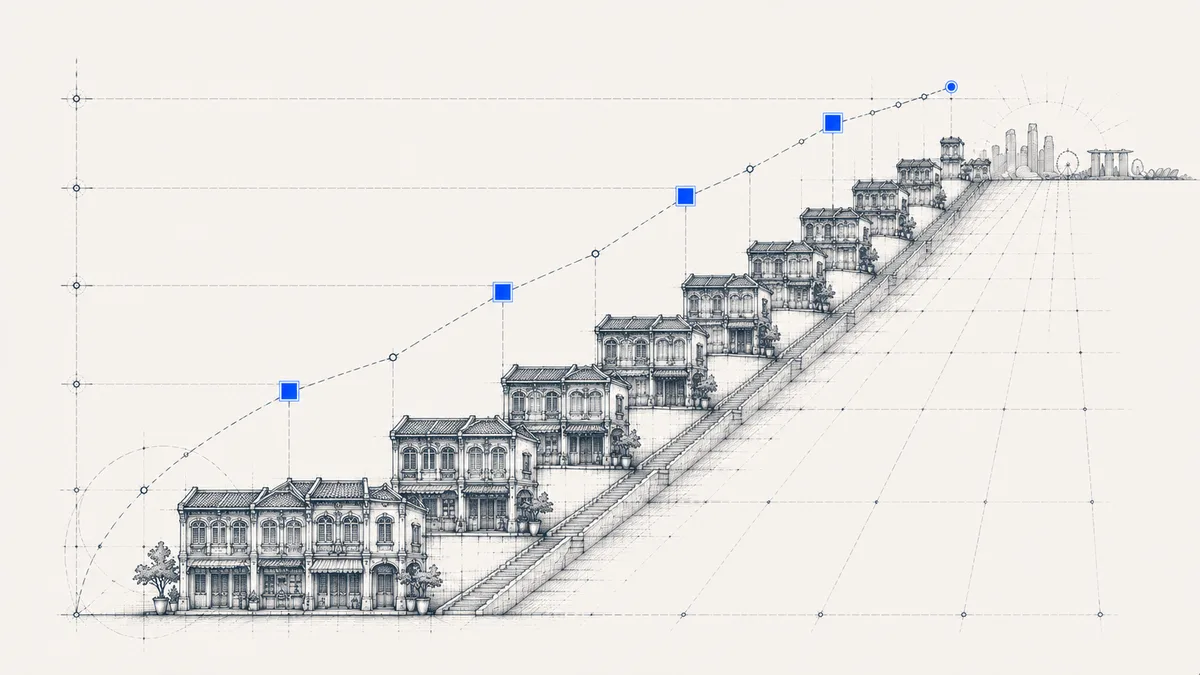
Singapore SME AI adoption tripled from 4.2% in 2023 to 14.5% in 2024, while large firms reached 62.5% (IMDA, Singapore Digital Economy Report 2025). That gap is the whole story: AI is moving fast in Singapore, but most small businesses still haven't started, which means early movers can still stand out. This piece lays out the hard numbers on adoption, the barriers holding SMEs back, the grants that cover up to half the bill, and where customer service fits in.
What percentage of Singapore SMEs are actually using AI in 2026?
About 14.5% of Singapore SMEs had adopted AI by 2024, up from just 4.2% the year before (IMDA, Singapore Digital Economy Report 2025). That is a tripling in a single year, so the trajectory is steep. But the absolute number is still low, which is exactly why this is an opportunity rather than a closed door.
Compare that to large firms. Non-SME AI adoption jumped from 44% to 62.5% over the same period (IMDA, Singapore Digital Economy Report 2025). So the big players have made AI normal, while most small businesses are still on the sidelines watching.
The honest read here is that you are not late. If you are an SME owner who hasn't touched AI yet, you are in the majority — roughly 85% of your peers haven't either. The firms that move now get to differentiate on service quality and response speed before AI becomes table stakes. Once SME adoption crosses 30 to 40%, the conversation shifts from "be an early mover" to "don't get left behind," and the easy advantage disappears.
It also helps to know the digital foundation is already strong. In 2024, 95.1% of SMEs had adopted at least one of six digital areas, and 97% adopted at least one sector-specific solution, up from 85% (IMDA, Singapore Digital Economy Report 2025). Singaporean SMEs are not digitally shy. They have just been slower to take the specific step into AI.
Where are Singapore businesses actually deploying AI?
Customer service is the second most common AI function among AI-using firms in Singapore, used by 43% of them (IMDA, Singapore Digital Economy Report 2025). It sits just behind IT (49%) and ahead of finance and accounting (40%). So if you are thinking about an AI agent for customer conversations, you are not experimenting on the fringe — you are following one of the most proven local use cases.
This matters because a lot of AI talk is vague hype about "transformation." The data says otherwise. Singapore firms are putting AI to work on concrete, repetitive functions where the savings are measurable, and customer service is right at the top of that list.
The tooling pattern is also telling. A full 84% of AI-using firms rely on off-the-shelf generative AI tools rather than building custom systems (IMDA, Singapore Digital Economy Report 2025). Nobody is asking small businesses to hire a data science team. The category that is winning is ready-made software you can switch on, which is precisely where an AI agent for customer service lives.
Here is what the adoption picture looks like in one view:
| Metric | Value | Source (year) |
|---|---|---|
| SME AI adoption 2023 | 4.2% | IMDA Singapore Digital Economy Report 2025 |
| SME AI adoption 2024 | 14.5% | IMDA Singapore Digital Economy Report 2025 |
| Non-SME AI adoption 2024 | 62.5% (up from 44%) | IMDA Singapore Digital Economy Report 2025 |
| SMEs adopting ≥1 digital area 2024 | 95.1% | IMDA Singapore Digital Economy Report 2025 |
| AI-using firms on off-the-shelf GenAI | 84% | IMDA Singapore Digital Economy Report 2025 |
| Customer service as an AI function | 43% (2nd most common) | IMDA Singapore Digital Economy Report 2025 |
| Workers using AI at work | 73.8% | IMDA Singapore Digital Economy Report 2025 |
One more number for context: 73.8% of Singapore workers use AI at work (IMDA, Singapore Digital Economy Report 2025). Your staff are already using these tools individually. The gap is organizational — turning scattered personal use into a system that actually serves your customers.
It's worth grasping the scale of who this applies to. Singapore has more than 300,000 enterprises, around 99% of which are SMEs, and together they employ roughly 70% of the workforce (SingStat and Enterprise Singapore). So when we talk about the SME AI gap, we are not talking about a niche — we are talking about almost the entire local business landscape. The digital economy itself hit S$128.1 billion, or 18.6% of GDP, in 2024 (IMDA, Singapore Digital Economy Report 2025), which tells you how much of Singapore's commercial activity now runs through digital channels. AI adoption is the next layer on top of a base that is already heavily digital.
What's stopping Singapore SMEs from adopting AI?
The two biggest barriers are cost of adoption and a lack of skilled staff, according to the Singapore Business Federation's National Business Survey. EY Singapore, citing IMDA and SBF data, confirms the same two barriers and notes that existing AI solutions are often "too expensive and not designed for resource-constrained SMEs." So the problem isn't that owners don't see the value — it's that the tools have felt out of reach.
The cost barrier connects to a deeper pain. Manpower cost is the single top business challenge in Singapore, cited by 66% of firms in the SBF National Business Survey 2024 Annual Business Sentiments Edition (64% of SMEs, 73% of large firms; n=519, fielded Oct–Nov 2024). A separate SBF reading, the 2024 Manpower and Wages Edition (796 companies, Jun–Jul 2024), put it even higher at 75% of firms. However you slice it, paying people is what keeps SME owners up at night.
That is what makes customer service automation the rare AI use case that attacks the actual problem. Hiring and staffing extended-hours support is expensive, and the SBF data shows that cost is already the number one strain. An AI agent that handles routine inquiries directly reduces the largest line item without requiring you to hire AI specialists you also can't afford.
There is a second pressure worth naming. Customer-demand uncertainty rose sharply from 30% in 2023 to 45% in 2024, becoming the second-top business challenge (SBF National Business Survey, released 2 Jan 2025). When demand is unpredictable, the appeal of automation grows: you cover service 24/7 without committing to fixed headcount you might not need next quarter.
There is also a quieter barrier the surveys hint at: the multilingual reality of serving Singapore customers. Per the 2020 Census, resident home-language use splits across English (48.3%), Mandarin (29.9%), other Chinese dialects (8.7%), Malay (9.2%), and Tamil (2.5%) (DOS/SingStat, Census 2020). Layer on 16.9 million international visitors in 2025, led by Mainland China, Indonesia, Malaysia, Australia, and India (Singapore Tourism Board), and the staffing math for in-language support becomes impossible for a small business. You cannot affordably hire native speakers across five languages for extended hours — but a single AI agent can detect and respond in each one from one knowledge base. That turns a structural cost into a competitive edge.
I won't pretend AI erases these barriers entirely. You still need to set it up properly, feed it accurate information, and decide when it hands off to a human. But the skills barrier is far lower than it was even two years ago, because off-the-shelf agents now do the heavy lifting that used to require engineers. If multilingual coverage is the part of your operation that bleeds money, our deeper look at multilingual AI customer service explains how one agent handles several languages without parallel translated content.
Will the Singapore government help pay for AI customer service?
Yes — the Productivity Solutions Grant (PSG) funds up to 50% of the cost, capped at S$30,000 per company per financial year, and since 2025 it explicitly covers generative AI solutions for marketing, sales, and customer engagement (Enterprise Singapore and IMDA). That is real money toward exactly the kind of AI agent that handles customer conversations. Always verify the live terms on the official EnterpriseSG and IMDA sites before you apply, because schemes change quarterly.
Singapore's grant ecosystem is unusually generous, and several programs stack onto customer-service AI specifically. Here are the main ones SME owners should know about:
- Productivity Solutions Grant (PSG) — up to 50% funding, capped at S$30,000 per company per financial year, run by Enterprise Singapore and IMDA. Since 2025 it covers GenAI tools for customer engagement, tested through the GenAI Sandbox. Eligibility generally requires being registered and operating in Singapore, at least 30% local shareholding for selected solutions, and turnover under S$100m or fewer than 200 employees.
- SkillsFuture Enterprise Credit (SFEC) — a one-time S$10,000 credit that can offset up to 90% of out-of-pocket costs.
- SMEs Go Digital (IMDA) — CTO-as-a-Service plus 300-plus pre-approved solutions, with AI-enabled options growing toward a 50% target.
- GenAI Sandbox for SMEs (EnterpriseSG and IMDA) — launched in February 2024; its "Customer Engagement" category is explicitly GenAI-powered chatbots. Sandbox 1.0 ran with 150-plus SMEs and roughly 80% continued after the three-month trial; Sandbox 2.0 launched in December 2024.
The proof that this pays off is in the numbers. SMEs that adopted AI-enabled solutions under the PSG reported average cost savings of 52% in 2024 (IMDA, SMEs Go Digital Day 2025). That is the government's own data showing that subsidized AI adoption isn't just cheaper to buy — it cuts ongoing costs by half on average.
The broader push is enormous. The Digital Enterprise Blueprint and National AI Impact Programme have supported more than 26,000 SMEs since May 2024, targeting 50,000 by 2029, with partners including Grab, DBS, SCCCI, Alibaba Cloud, Microsoft, and Google (IMDA). The runway is there. The question is whether you take it before your competitors do.
How much does an AI agent cost a Singapore SME, and what's the payback?
Modern AI agent platforms start far cheaper than a single part-time hire, and Singapore grants can cover up to half the cost. Pricing typically runs in tiers, so you start small and scale as volume grows rather than committing to enterprise contracts.
For a concrete reference point, Omago, an AI agent platform that helps SMEs automate customer conversations across WhatsApp, Telegram, and web chat, prices in clear tiers: a free plan with 50 messages, then Core at US$49, Plus at US$99, and Max at US$369 per month, with annual billing saving two months. WhatsApp and Telegram channels start at the Plus tier. Compare any of those to a monthly salary in Singapore, where manpower cost is the top business challenge cited by 66% of firms (SBF, 2024), and the math gets obvious fast.
The smarter way to think about payback is enquiry volume, not just the sticker price. An agent that handles routine questions around the clock typically reaches break-even at a modest daily volume of inquiries, and once you layer in the PSG's up-to-50% subsidy and the 52% average cost savings IMDA reported in 2024, the payback window is short. The point isn't a magic number — it's that the cost structure has flipped. What used to require a salaried team is now a software subscription that the government will partly fund.
A word of caution: an AI agent is not a fire-and-forget purchase. The savings show up when you set it up well — accurate knowledge base, clear handoff rules, honest disclosure that customers are talking to AI. Treat it like hiring a capable new team member who needs good onboarding, and the ROI follows. Skip that work and you'll get a frustrating bot, subsidy or not. If you want the full breakdown, our guide to the real cost of AI agents for small business walks through every line item.
Does an AI agent do more than answer questions?
Yes — the meaningful difference in 2026 is between a chatbot that replies and an AI agent that takes actions. A basic chatbot follows scripted rules and answers FAQs. An AI agent reasons over your information, holds context across a conversation, captures and routes leads, runs guided multi-step flows, and triggers actions in your other systems before handing off cleanly to a human when needed.
This distinction matters for ROI because answering questions is only half the value. The other half is what happens after the answer — booking the appointment, qualifying the lead, logging the inquiry, updating a record. Omago, for example, integrates with tools like Airtable so the agent can act on a conversation, not just talk through it. That's the gap between deflecting a message and actually moving a customer forward.
It also changes how you should evaluate vendors. Most AI-using Singapore firms run off-the-shelf generative AI (84%, per IMDA's 2025 report), so the tools are accessible — but "off-the-shelf" still ranges from a dumb FAQ widget to a reasoning agent. Ask what it can do, not just what it can say. If you're weighing the categories, our comparison of AI agents vs live chat vs chatbots lays out where each one fits.
The honest limit: even the best agent shouldn't handle everything. Complex complaints, edge cases, and high-stakes decisions still belong with humans. The goal is to let the agent absorb the routine 24/7 volume — which is most of it — so your people spend their time where judgment actually matters. As one way to frame it, an agent keeps you reachable even after hours: stay open while you're closed.
Frequently Asked Questions
What percentage of Singapore SMEs use AI in 2026?
Roughly 14.5% of Singapore SMEs had adopted AI as of 2024, tripling from 4.2% in 2023 (IMDA, Singapore Digital Economy Report 2025). Large firms were far ahead at 62.5%. The trajectory is steep but absolute SME adoption remains low, so early movers can still differentiate before AI becomes standard.
Can Singapore SMEs get a government grant for AI customer service?
Yes. The Productivity Solutions Grant funds up to 50% of the cost, capped at S$30,000 per company per financial year, and since 2025 it explicitly covers GenAI customer-engagement tools (Enterprise Singapore and IMDA). The SkillsFuture Enterprise Credit adds a one-time S$10,000 offset. Verify the current terms on the official EnterpriseSG and IMDA sites before applying, as schemes change quarterly.
What is the most common way Singapore businesses use AI?
Among AI-using firms, the top functions are IT (49%), customer service (43%), and finance and accounting (40%) (IMDA, Singapore Digital Economy Report 2025). Customer service is one of the most proven local AI use cases, not an experiment. Most firms (84%) use off-the-shelf generative AI tools rather than building custom systems.
What are the biggest barriers stopping SMEs from adopting AI?
Cost of adoption and a lack of skilled staff are the two leading barriers, confirmed by both the SBF National Business Survey and EY Singapore. Manpower cost is the top overall business challenge, cited by 66% of firms in the SBF 2024 Annual Business Sentiments Edition. An AI agent for customer service targets that top cost directly while requiring no in-house AI expertise.
How much do Singapore SMEs save by adopting AI?
SMEs that adopted AI-enabled solutions under the Productivity Solutions Grant reported average cost savings of 52% in 2024 (IMDA, SMEs Go Digital Day 2025). AI-powered cybersecurity solutions saw even higher savings of 71%. Combined with the PSG covering up to half the upfront cost, the payback window for customer-service automation is typically short.
Sources: IMDA Singapore Digital Economy Report 2025; IMDA SMEs Go Digital Day 2025; Singapore Business Federation National Business Survey 2024 (Annual Business Sentiments Edition; Manpower and Wages Edition); EY Singapore; Enterprise Singapore; SkillsFuture Singapore.