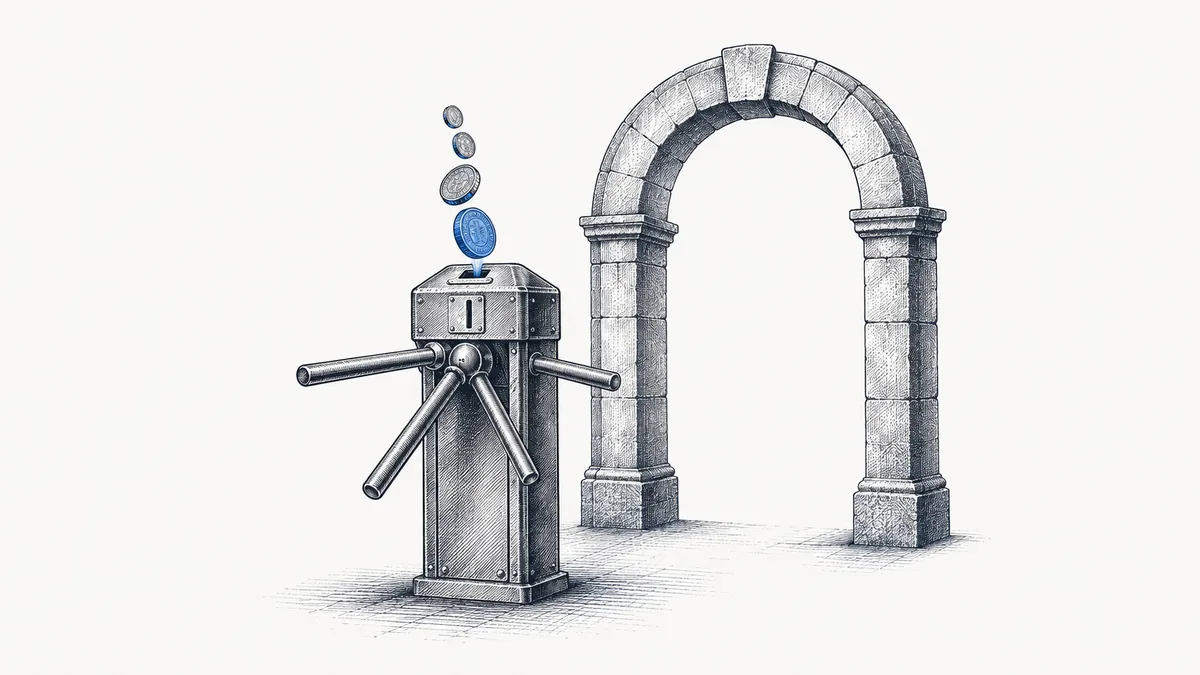
You paid Google or Meta for the click. The enquiry arrives at 11pm, the AI answers it, the customer reads the answer and closes the tab — and you are billed US$0.99, because under Fin's pricing a customer who goes quiet after the AI's last message counts as a resolution (Intercom, 2026). That one definition, buried in a help-centre article, is the whole story of per-resolution pricing. So what does 500 conversations a month actually cost? At a realistic 50% resolution rate, about US$276.50 a month — US$247.50 in Fin outcomes plus the cheapest seat underneath it (Intercom, 2026, prices checked 2026-09-21). This article breaks down where every dollar of that comes from, what Intercom does and does not count as a resolution, what the same volume costs under per-seat and flat models, and what the Salesforce acquisition might do to the number.
How much does Intercom Fin cost per month in 2026?
Fin costs US$0.99 per outcome, with a minimum of 50 outcomes a month, charged on top of a seat plan that starts at US$29 per seat per month on annual billing (Intercom, 2026; Fin, 2026 — prices checked 2026-09-21). There is no single sticker price, which is exactly why owners get surprised by the invoice.
The unit you are buying is an "outcome," not a ticket and not a conversation. Fin counts four kinds. A resolution, a procedure handoff, and a disqualification each cost US$0.99. A lead qualification — the sales-side outcome — costs US$9.99 (Fin, 2026). You are charged once per conversation even if Fin takes several actions inside it, which is a genuinely fair piece of design and worth crediting.
Two mechanics matter for budgeting. First, the 50-outcome monthly floor: you pay for at least 50 outcomes (US$49.50) whether or not you generate them. Second, unused outcomes do not roll over (Fin, 2026). The floor only binds below roughly 100 conversations a month, so for most businesses running ads it is irrelevant — your problem is the ceiling, not the floor.
There is also a standalone path. Fin can run on top of another helpdesk — Zendesk, Salesforce, and others — with "no seats required," billed at the same US$0.99 per outcome (Intercom, 2026). One Fin help article for that standalone product cites a US$49/month subscription with 50 resolutions included before per-resolution billing starts (Intercom, 2026). Treat that as a standalone-specific figure, not the price you will see on the seat-based path; the two routes are quoted differently and the difference is not signposted on the main pricing page.
Naming has also shifted: Intercom renamed itself Fin in May 2026, so an old quote and a new one may be the same product under two names.
What counts as a resolution in Fin's pricing?
A resolution is counted when the customer either confirms the answer was good or simply leaves without asking for more help. Intercom's own definition is explicit: "A resolution is a type of outcome that is counted when, following Fin's last answer in a conversation, the customer either confirms the answer was satisfactory (confirmed resolution), or exits the conversation without requesting further assistance (assumed resolution)" (Intercom, 2026).
That second half — the assumed resolution — is the clause that decides your bill. Silence is billed as success. A customer who got a useless answer and gave up looks identical, in the billing data, to a customer who got exactly what they needed and left happy.
To Intercom's credit, the guardrails around it are real and published:
- Fin responding to a greeting does not count as an outcome.
- If Fin asks a clarifying question and the customer never replies, the auto-close is not billable.
- If a customer returns to the same conversation asking for more help — even across billing periods — the resolution "will be deducted and not charged" (Intercom, 2026).
Those three rules remove the worst of the abuse cases, and they are more generous than most buyers assume. But they do not touch the core issue: a customer who is dissatisfied and never comes back is still billed as a resolution, because from the system's point of view nothing happened.
This is the recurring complaint in Intercom's own community, where users describe "Fin's flawed assumed resolved & pricing design" and draw the distinction the billing does not — a hard resolution (thumbs-up, or an explicit "yes, thanks") versus a soft resolution (the customer simply exits within 24 hours of Fin's last answer) (Intercom Community, 2026). Independent reviewers make the same point about the all-in bill being hard to forecast because assumed resolutions stack on top of seat fees (Getmacha, 2026).
If you want the deeper version of this argument — why "the conversation ended" and "the problem got solved" are different numbers, and how to tell them apart in your own data — it is the subject of our piece on containment versus resolution as an AI metric. Per-resolution pricing is that measurement problem with a price tag attached to it.
What does 500 conversations a month really cost?
At 500 conversations a month with a 50% resolution rate, Fin costs roughly US$276.50 a month all-in on the cheapest seat plan. Here is the arithmetic at three volumes, using a 50% resolution rate and one Essential seat at US$29 on annual billing (Intercom, 2026; prices checked 2026-09-21):
| Conversations/month | Resolutions at 50% | Fin outcome fee | Minimum seat | Total per month |
|---|---|---|---|---|
| 200 | 100 | US$99.00 | US$29 | ~US$128 |
| 500 | 250 | US$247.50 | US$29 | ~US$276.50 |
| 2,000 | 1,000 | US$990.00 | US$29 | ~US$1,019 |
The formula behind the table is worth memorising, because it is the only honest way to forecast the bill:
max(50, conversations × your real resolution rate) × US$0.99 + seats + add-ons
Two caveats keep this table conservative rather than alarmist. The 2,000-conversation row assumes a single seat, which no real support team runs — at that volume you are almost certainly on Advanced (US$85 per seat per month annually) with two or three seats, so the true figure is closer to US$1,150–1,250. And the 50% resolution rate is an assumption, not a promise; it is the number that moves everything else in the row.
Notice what the table does to your planning. Doubling your ad spend does not double your software cost — it quadruples the gap between the 500 and 2,000 rows. Per-resolution pricing converts a fixed cost into a variable one that tracks the exact metric you are trying to grow. That is fine if your margin per conversation is high. It is punishing if you are a high-volume, low-ticket business.
What is the seat plan sitting underneath Fin?
Fin is an add-on, not a standalone product on the seat-based path, so every outcome fee sits on top of a per-seat subscription. Published seat pricing as of the check date is (Intercom, 2026, annual / monthly billing):
| Plan | Per seat/month (annual) | Per seat/month (monthly) | Included Lite seats |
|---|---|---|---|
| Essential | US$29 | US$39 | — |
| Advanced | US$85 | US$99 | 20 |
| Expert | US$132 | US$139 | 50 |
Lite seats are limited-access collaborators — people who need to read and comment but not work the queue — not full agents, so do not count them as headroom for your support team.
Then there are the add-ons, which is where quoted budgets usually break. Copilot, the agent-facing AI that drafts replies for your humans, is a separate US$29 per agent per month. Proactive Support Plus is US$99 a month. The Pro add-on starts at US$99 a month (Intercom, 2026). None of those are unreasonable individually; together they are how a "US$29 plan" becomes a four-figure invoice.
So the honest read of Fin's price is three layers, not one: seats, outcomes, add-ons. When you ask for a quote, ask for all three broken out, and ask what the vendor assumes your resolution rate will be — because that assumption is doing most of the work.
Why does the 76% resolution rate change your bill?
Because under per-resolution pricing, a higher resolution rate is a higher invoice. Fin's own marketing states it "has industry leading resolution rates, averaging 76% across 12,000+ customers, with many seeing over 85%," and Salesforce's acquisition release repeats that Fin "resolves, on average, 76 per cent of support volume without a human" (Fin, 2026; Salesforce, 2026).
Run that number through the formula. At 500 conversations a month, 76% is 380 resolutions — US$376.20 in outcome fees, not US$247.50. At 2,000 conversations it is 1,520 resolutions, or US$1,504.80. The better the AI performs, the more you pay, which is the defining feature of the model and the thing most buyers do not price in.
The counter-evidence runs the other way, and both sides are worth knowing. One independent analysis puts documented production deployments at 45–53%, describing "a 23–31 point gap between what you're told to expect and what teams actually see" (CloneDesk, 2026). Intercom's own pricing page quotes a customer at a 50% resolution rate, and its Linktree case study reports Fin resolving 42% of conversations within six days (Intercom, 2026). That 45–53% range comes from a single secondary analysis rather than a primary dataset, so treat it as directional — but it is corroborated by Intercom's own published customers, which is what makes it credible.
Here is the uncomfortable symmetry. At 45% resolution your Fin bill is low and your human workload stays high; at 76% the bill nearly doubles but your staffing cost drops. Neither is automatically better — what matters is whether the labour you save costs more than the outcomes you buy. Model your bill on your own knowledge-base quality, not the 76% headline, which pools the most mature accounts while the ones that gave up quietly drop out of the dataset.
How does per-resolution pricing compare to per-seat and flat models?
Per-resolution is one of five pricing models in this market, and it is the only one whose cost rises in direct proportion to how well the software works. Here is the same 500 and 2,000-conversation workload priced across the main options, with Meta and WhatsApp per-message fees excluded throughout (research compiled 2026-09-21; all figures are planning estimates, not quotes):
| Tool | Model | ~500 conversations/mo | ~2,000 conversations/mo |
|---|---|---|---|
| Intercom Fin | Per resolution (US$0.99) | ~US$247 + seats | ~US$990 + seats |
| Zendesk AI agents | Per seat + per resolution | ~US$553 | ~US$1,865 |
| respond.io | Per monthly active contact + seat | ~US$159 | ~US$179–219 |
| WATI | Per-seat plan + per-message | ~US$59 + message fees | ~US$119 + message fees |
| Crisp | Flat per workspace | ~US$95 + AI credits | ~US$95 + AI credits |
| Omago | Flat monthly | US$49–99 | US$49–99 |
Zendesk deserves its own warning line. Its AI agents bill roughly US$1.50 per resolution on a committed plan and US$2.00 pay-as-you-go, and since January 2026 resolution overages are auto-billed with no cap (Coworker AI, 2026; eesel AI, 2026). Those per-resolution rates are not officially published by Zendesk — they are convergent third-party and customer reports, so treat them as approximate. An uncapped overage on a variable metric is the single most-cited cost surprise of 2026 in this category.
Omago sits at the other end of that table for one structural reason, not because it is better at answering: it charges a flat US$49–99 a month with no per-resolution fee, so the bill does not move when a campaign works. It is a Hong Kong-built AI sales agent that answers on your website and WhatsApp in any language, qualifies the enquiry and books the appointment. It does not have Fin's helpdesk depth, its ticketing, or its enterprise reporting — if you are running a real support organisation with queues, SLAs and workflows, Fin is a more complete product and the per-outcome fee is buying you something. The flat fee matters when your problem is not ticket management but the paid click that arrives at 11pm and leaves unanswered. You can see the full tier breakdown on our pricing page, and the wider field is laid out in our guide to the best AI customer service software for small business in 2026.
What does the Salesforce acquisition mean for Fin's price?
Nothing yet — but it is the biggest single variable in any multi-year Fin contract you sign this year. On 15 June 2026, Salesforce announced a definitive agreement to acquire Fin, formerly Intercom, for approximately US$3.6 billion, with the deal expected to close in Salesforce's fiscal Q4 2027 (Salesforce, 2026).
As of the check date, pricing is unchanged. The US$0.99 outcome fee, the 50-outcome floor, and the seat tiers are all as published before the announcement. Nobody has repriced anything.
What is worth planning for is packaging, not the headline rate. When an acquired product folds into a larger agent platform, the common pattern is not a price rise on the old SKU but a migration path onto new bundles where the unit economics are different. If you are being asked to commit to two or three years to unlock a discount, that is the clause to negotiate: ask in writing what happens to your per-outcome rate and your seat count if the product is repackaged post-close.
The same goes for the resolution definition. Your bill is a function of wording the vendor controls and can revise, so a contract that locks the price but not the definition has locked half the number.
When is per-resolution pricing actually the right deal?
When your conversation volume is low, your margins per customer are high, and your knowledge base is genuinely good. Per-resolution is not a trap — it is a model with a specific shape, and for some businesses that shape fits.
It works well when:
- You handle under about 200 conversations a month, where the total lands near US$128 and the variable component is small enough to ignore.
- Each resolved conversation is worth far more than a dollar — a professional services firm resolving a client question is not agonising over US$0.99.
- You genuinely want to pay only when the AI does something, and you would rather have a variable cost than a fixed one during a pilot.
- You need the helpdesk underneath — ticketing, routing, reporting — and would be paying for a platform anyway.
It works badly when:
- Volume is high and ticket value is low, so the fee-per-outcome is a meaningful share of the transaction.
- Your volume is spiky — a campaign, a product launch, a seasonal peak — and a variable bill arrives in exactly the month your cash is tightest.
- You cannot tolerate an unforecastable line item, which is most owner-operated businesses.
- Your real job is capturing ad-driven enquiries rather than managing a support queue, in which case you are buying a helpdesk to solve a response-speed problem.
Whichever model you choose, run the arithmetic on your own numbers before you sign: your real monthly conversations, your realistic resolution rate, your seat count, and every add-on quoted separately. If you want to compare the cheaper DIY end of the market on the same basis, we do that in Tidio vs Chatbase vs Crisp.
And if you would rather test than read: paste your website URL into the demo on the Omago homepage and ask the agent a question only your own customers would ask.
Frequently asked questions
How much is Intercom Fin per resolution in 2026?
Fin is US$0.99 per outcome, where an outcome is a resolution, a procedure handoff, or a disqualification; a sales-side lead qualification is US$9.99 (Fin, 2026, checked 2026-09-21). There is a 50-outcome monthly minimum and unused outcomes do not roll over. That fee sits on top of a seat plan starting at US$29 per seat per month on annual billing.
Does Intercom charge you when a customer just stops replying?
Yes. Intercom's definition counts an "assumed resolution" when the customer exits the conversation without requesting further assistance after Fin's last answer (Intercom, 2026). There are exceptions: a greeting alone is not billable, an unanswered clarifying question that auto-closes is not billable, and if the customer returns to the same conversation for more help the resolution is deducted and not charged.
What does Fin cost at 500 conversations a month?
About US$276.50 a month at a 50% resolution rate — 250 resolutions at US$0.99 (US$247.50) plus one Essential seat at US$29. At Fin's marketed 76% resolution rate the same volume costs about US$405 a month, because the outcome fee rises as the AI succeeds. Add-ons such as Copilot (US$29 per agent per month) are extra.
Is Intercom Fin cheaper than Zendesk AI agents?
At comparable volumes, yes. Fin's US$0.99 per resolution is roughly half Zendesk's reported US$1.50 committed / US$2.00 pay-as-you-go rate, which puts 2,000 conversations at about US$990 for Fin versus about US$1,865 for Zendesk (Coworker AI, 2026; eesel AI, 2026). Zendesk also auto-bills resolution overages with no cap since January 2026. Zendesk's per-resolution rates are not officially published, so treat them as approximate.
Will the Salesforce acquisition change Fin's pricing?
Not as of 21 September 2026. Salesforce signed a definitive agreement to acquire Fin for approximately US$3.6 billion on 15 June 2026, with closing expected in its fiscal Q4 2027, and published pricing has not changed since (Salesforce, 2026). The risk to plan for is repackaging after close rather than a rate rise, so get your per-outcome rate and the resolution definition written into any multi-year contract.
Sources: Intercom (2026); Fin (2026); Intercom Community (2026); Salesforce newsroom (2026); CloneDesk (2026); Getmacha (2026); Coworker AI (2026); eesel AI (2026). All prices checked 2026-09-21 and subject to change; figures in this article are planning estimates, not quotes.