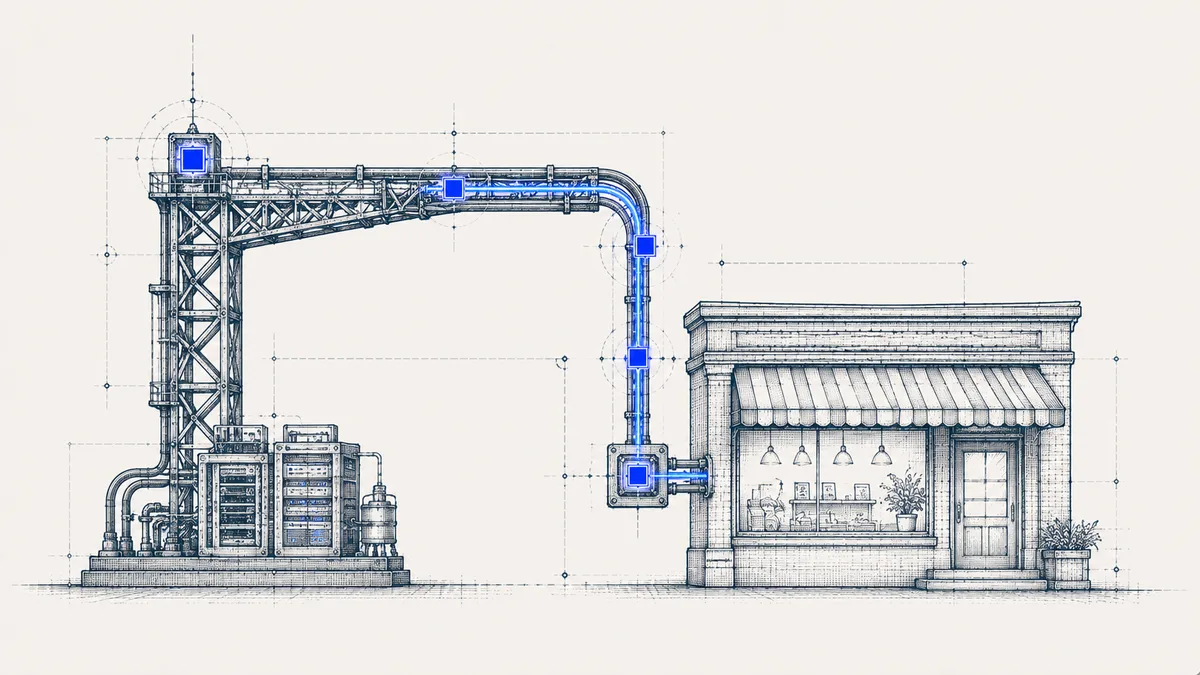
The Singapore government set aside up to S$150 million for the Enterprise Compute Initiative in Budget 2025 to give firms access to AI tools, compute and consultancy through the major cloud providers (EDB / The Edge Singapore, Feb 2025). If you run an SME and you've heard the term "GenAI grant" thrown around but can't figure out which scheme is real, which is open, and which actually pays for an AI customer service tool — this is your map. Below I'll walk through the newer GenAI-specific rails (ECI, the GenAI Sandbox, and the Budget 2026 AI tax incentives), how they differ from the everyday Productivity Solutions Grant, and how to stack them sensibly.
What GenAI funding is actually available to Singapore SMEs in 2026?
There are several distinct schemes, and they do different jobs — the GenAI-specific ones (Enterprise Compute Initiative, GenAI Sandbox, the AI tax deductions in Budget 2026) sit alongside the long-running operational grants like PSG. Most SME owners confuse them because the government markets them under one "AI support" banner, but they pay for completely different things and have different eligibility rules.
The short version: the Enterprise Compute Initiative (ECI) pairs eligible enterprises with AWS, Google Cloud and Microsoft for AI tools, compute and consultancy. The GenAI Sandbox lets SMEs trial pre-vetted generative-AI tools for marketing, sales and customer engagement. Budget 2026 layered on AI-specific tax deductions and an expanded grant landscape. And underneath all of it, the Productivity Solutions Grant (PSG) remains the workhorse that funds off-the-shelf software adoption — including AI chatbots.
If you only want a deployed AI agent answering customer enquiries, PSG is usually the fastest route, and I cover that scheme in depth in the PSG grant guide for AI customer service in Singapore. This article focuses on the newer, GenAI-flavored schemes that get less plain-English coverage.
What is the Enterprise Compute Initiative and how do I apply?
The Enterprise Compute Initiative (ECI) is a Budget 2025 programme — backed by up to S$150 million — that partners eligible enterprises with major cloud providers (AWS, Google Cloud, Microsoft) to get AI tools, compute capacity and consultancy (EDB / The Edge Singapore, Feb 2025). It was announced by then-Prime Minister and Finance Minister Lawrence Wong when he delivered Budget 2025 in February 2025.
ECI is structurally different from a typical reimbursement grant. Instead of you buying software and claiming back 50%, ECI is about giving firms access to the compute and expert guidance needed to build or run AI workloads with a cloud partner. Think of it as the heavy-infrastructure end of the spectrum: it suits a company doing something compute-intensive — training or running models, processing large data sets — rather than a café that just wants a booking bot.
Here's the honest caveat. Application mechanics for ECI run through the cloud partners and EDB-linked channels rather than the self-serve Business Grants Portal, and the exact intake process has evolved since launch. Before you build a plan around ECI, confirm current eligibility and the application route directly with EDB or your cloud provider, because this is a fast-moving programme and the figures and process here reflect what was announced as of the 2025–2026 period.
What is the GenAI Sandbox for SMEs?
The GenAI Sandbox for SMEs is a joint Enterprise Singapore and IMDA initiative that let SMEs test pre-selected generative-AI tools for marketing, sales and customer engagement — and selected solutions then became eligible for up to 50% PSG support. In plain terms, it's a "try before you commit" rail that feeds qualifying tools into the regular grant pipeline.
The logic is smart for a skeptical SME owner. Rather than betting budget on an AI tool you've never used, the Sandbox lowered the trial cost so you could see whether the thing actually moves the needle on enquiries handled or leads captured. If it works, the same category of solution can then attract PSG funding for the full deployment.
This is also where the GenAI funding story connects back to the everyday grant. The Sandbox doesn't replace PSG — it routes into it. So the "GenAI Sandbox" and "PSG" you keep seeing mentioned together aren't competing options; they're two stops on the same path. The broader umbrella here is SMEs Go Digital, the IMDA programme that pre-approves digital solutions for PSG across 22 sector-specific Industry Digital Plans and surfaces them through the CTO-as-a-Service platform. Over 400,000 users accessed CTO-as-a-Service in 2024, browsing 300+ pre-approved solutions, 30% of which were AI-enabled — up from 20% in 2023 (IMDA, SMEs Go Digital Day, 2025).
That jump from 20% to 30% AI-enabled solutions in a single year tells you something about where the government is pushing. The CTO-as-a-Service platform now includes a "Go Digital Advisor" covering customer service specifically, and IMDA has run a Customer Engagement Chatbot Call-for-Proposal aimed at next-generation chatbots. If you've ever felt that "AI for SMEs" was all talk and no plumbing, this is the plumbing — a pre-vetting and discovery layer designed so a non-technical owner can find a solution that's already been checked for grant eligibility. It's not perfect, and the directory can feel sprawling, but it beats cold-Googling vendors and hoping one of them qualifies.
How does Budget 2026 change AI funding for SMEs?
Budget 2026, delivered in February 2026, broadened AI support in three concrete ways: it expanded PSG to cover more AI-enabled solutions, it added AI expenditure as a qualifying activity under the Enterprise Innovation Scheme, and it announced new AI programmes plus a consolidated grant. These changes matter because they shift AI from a "nice to have" into something the tax code and grant system now actively reward.
The headline tax move is the Enterprise Innovation Scheme (EIS), which was expanded to include AI expenditure as a qualifying activity — offering a 400% tax deduction on up to S$50,000 of qualifying spend per year for YA2027–2028 (InCorp / Budget 2026). That's a meaningful sweetener if your business is profitable enough to use deductions. Budget 2026 also introduced a 40% Corporate Income Tax rebate for YA2026, capped at S$30,000.
On the programme side, Budget 2026 launched a new "Champions of AI" programme (Enterprise Singapore + Digital Industry Singapore) and the National AI Impact Programme (NAIIP), which targets 10,000 enterprises and 100,000 workers over three years. The Market Readiness Assistance (MRA) grant was also enhanced to up to 70% for SMEs from 1 April 2026, up from 50%.
One important structural note: a new consolidated grant called EDGE will streamline MRA, PSG and EDG into a single scheme, launching in the second half of 2026. Until EDGE goes live, PSG, EDG and MRA all remain open via the Business Grants Portal (Enterprise Singapore Budget 2026 page; InCorp; Funding Societies, 2026). Treat every date and status here as current per the 2026 sources — these schemes are being actively reshaped, so verify before you apply.
Which scheme should I use to fund an AI customer service tool?
For most SMEs deploying an off-the-shelf AI agent to handle customer enquiries, PSG is the right starting point — it covers up to 50% of qualifying costs, capped at S$30,000 per company per financial year (Enterprise Singapore, 2026). The GenAI-specific schemes are better suited to heavier or more bespoke AI work, or function as tax sweeteners rather than the primary funding source.
Here's the practical decision logic. If you want a deployed AI agent answering bookings and FAQs across web chat and messaging, look at PSG first because customer management software is a pre-approved category. If you're running something compute-heavy with a cloud partner, ECI is the relevant rail. If you're profitable and want to reduce your tax bill on AI spend, the EIS deduction stacks on top. And if you simply want to trial GenAI tools cheaply before committing, the GenAI Sandbox lowers that first step.
Here's how the main schemes compare side by side:
| Scheme | Support level | Cap / size | Year / status | Best for |
|---|---|---|---|---|
| PSG (Productivity Solutions Grant) | Up to 50% of qualifying costs | S$30,000 per company per FY | Current; 50% since 1 Apr 2023; expanded for AI under Budget 2026 | Off-the-shelf AI chatbot / customer management software |
| Enterprise Compute Initiative (ECI) | Cloud credits + consultancy | Up to S$150m total programme | Budget 2025 (Feb 2025) | Compute-intensive AI builds with a cloud partner |
| GenAI Sandbox for SMEs | Lowered trial cost; routes to PSG | Per-solution | EnterpriseSG + IMDA; feeds 50% PSG support | Trialing GenAI marketing/sales/CX tools |
| EIS — AI expenditure | 400% tax deduction | S$50,000/yr qualifying | YA2027–2028 | Profitable firms reducing tax on AI spend |
| MRA (Market Readiness Assistance) | Up to 70% for SMEs | Per-scheme cap | Enhanced from 1 Apr 2026 (was 50%) | Overseas market expansion |
| EDGE (consolidated grant) | Replaces PSG/EDG/MRA | TBA | Launching H2 2026 | Future single-application route |
A quick reality check before you get excited: a grant or tax deduction does not make a bad AI deployment good. It just lowers the price of a deployment you should only do if it solves a real problem — too-slow response times, after-hours enquiries going dark, staff drowning in repetitive questions. The funding is the discount, not the strategy.
What does an AI agent funded this way actually do for an SME?
A funded AI agent should take real work off your team — answering common questions, capturing and routing leads, and running guided multi-step flows like a booking or an enquiry intake — not just spitting out canned replies. That's the difference between a glorified FAQ widget and something that earns its keep, especially for a small team under pressure.
This matters in Singapore specifically because the labour math is brutal. Singapore averaged 75,900 job vacancies in 2025, with 1.58 vacancies per job seeker and a 3.1% job vacancy rate in December 2025 — well above the 2000–2019 quarterly average of 2.3% (Ministry of Manpower, Job Vacancies Report 2025, released March 2026). When you genuinely can't hire fast enough — and the services sector faces some of the tightest foreign-worker quotas of any sector — automating repetitive customer service becomes one of the few cost levers an SME actually controls.
The pressure is sharpest in customer-facing sectors. In retail, an NTUC LearningHub report found that 93% of retail employees agreed there was a manpower shortage and 44% planned to leave the sector within a year (NTUC LearningHub Industry Insights Report on Retail, 2022). That's the backdrop against which a funded AI agent stops being a tech indulgence and starts looking like basic operational hygiene: if the humans you can hire are scarce, expensive and likely to churn, you want them spending their hours on the work that genuinely needs a person, not retyping your opening hours for the fortieth time today.
The honest boundary: an AI agent is excellent at the high-volume, low-judgment work and should hand off to a human for complaints, refunds, disputes and anything requiring empathy or goodwill. If you want help drawing that line, the when to automate versus hire framework is a useful companion. Tools like Omago, an AI agent platform that helps SMEs automate customer conversations across WhatsApp, Telegram, and web chat, are the kind of off-the-shelf solution category that fits the PSG model — though you should always confirm current eligibility and the approved-vendor listing yourself before assuming any specific tool qualifies. Omago's published pricing runs from a free tier (50 messages) through Core at US$49, Plus at US$99, and Max at US$369 per month, with annual billing saving two months.
How do I stack these schemes without wasting money?
Stack from the bottom up: start with the operational grant that funds the actual tool (PSG), layer the GenAI Sandbox if you want a low-cost trial first, and use the EIS tax deduction afterward to reduce the cost of the qualifying AI spend. Don't try to chase every scheme at once — that's how SMEs burn weeks on paperwork for funding they were never eligible for.
A sensible sequence looks like this:
- Define the problem first. Write down the specific customer service pain — slow replies, after-hours gaps, repetitive FAQs eating staff time. No problem, no point funding a solution.
- Trial via the GenAI Sandbox if available. Test a generative-AI customer-engagement tool at lowered cost before committing budget.
- Apply for PSG before signing anything. Critically, you must not sign a contract or pay a deposit before approval — pre-payment voids the application. Apply via the Business Grants Portal with CorpPass; processing runs roughly four to six weeks.
- Claim the EIS deduction on qualifying AI spend. If your business is profitable, the 400% deduction (up to S$50,000/yr, YA2027–2028) lowers the after-tax cost further.
- Watch for EDGE. If you're planning a 2027 project, the consolidated EDGE grant launching in H2 2026 may change the application route entirely.
The thing nobody tells you: most of these schemes are reimbursement-based or deduction-based, meaning you pay first and recover later. Budget your cash flow for the full amount upfront. And because the rules are genuinely shifting in 2026 — EDGE consolidation, MRA enhancement, EIS expansion — anything you read (including this) should be cross-checked against the official Enterprise Singapore and IMDA pages before you commit. Stay open while you're closed, but don't sign blind.
Frequently Asked Questions
Is the Enterprise Compute Initiative the same as PSG?
No. The Enterprise Compute Initiative (ECI) is a Budget 2025 programme — up to S$150 million — that connects enterprises with cloud providers for AI tools, compute and consultancy (EDB / The Edge, Feb 2025). PSG is a separate, ongoing grant that reimburses up to 50% of the cost of pre-approved software, capped at S$30,000 per financial year. ECI suits compute-heavy AI builds; PSG suits off-the-shelf adoption like an AI chatbot.
Can I get a GenAI grant for an AI chatbot in Singapore?
In most cases, you'd fund an AI chatbot through PSG rather than a dedicated "GenAI grant." Customer management software is a pre-approved PSG category, and the GenAI Sandbox routes qualifying generative-AI tools into PSG support. Always confirm the specific solution is currently listed and that your company meets eligibility before applying.
How much is the AI tax deduction under Budget 2026?
Budget 2026 expanded the Enterprise Innovation Scheme (EIS) to treat AI expenditure as a qualifying activity, offering a 400% tax deduction on up to S$50,000 of qualifying spend per year for YA2027–2028 (InCorp / Budget 2026). Budget 2026 also introduced a 40% Corporate Income Tax rebate for YA2026, capped at S$30,000.
What is EDGE and when does it launch?
EDGE is a new consolidated grant announced in Budget 2026 that will streamline MRA, PSG and EDG into a single scheme. It's slated to launch in the second half of 2026. Until then, PSG, EDG and MRA all remain open via the Business Grants Portal (Enterprise Singapore Budget 2026; Funding Societies, 2026).
Do I have to pay first and claim later?
For PSG, yes — it works on a reimbursement basis, so you pay the vendor and claim back the approved percentage, with processing of roughly four to six weeks. Crucially, you must not sign a contract or pay a deposit before approval, as pre-payment voids the application. Budget for the full cost upfront and treat the grant as a later recovery.
Sources: EDB / The Edge Singapore (Feb 2025); Enterprise Singapore (2026); Enterprise Singapore Budget 2026 page; IMDA, SMEs Go Digital Day (2025); Ministry of Manpower, Job Vacancies Report 2025 (Mar 2026); InCorp (2026); Funding Societies (2026)